
CREEP BOX

If you’re a paranormal enthusiast, you’ve heard of the average ghost tour. If you’re a little more intense, you download the Ghost Radar app and casually track color-coded spirits wandering in your vicinity. But, if you’re serious about the other side, book a psychic guided tour on the Queen Mary for your first wedding anniversary, paying extra for the EVP Spirit Box seance, like I did. 5 stars. Highly recommend. Patrick Biesemans’ CREEP BOX pits science and grief against each other in a disturbing and psychologically unsettling manner.
 Dr. Franklin Caul has created a simulated consciousness with the dead. The DOJ wants it, but Caul has ulterior motives. The tech uses data from the deceased to have conversations or seek answers. In the mix is a swirl of overlapping thoughts and confusion that get under your skin. You cannot help but listen to them, and they are chilling. Caul observes that when suicide is the cause of death, the deterioration of self slows.
Adam David Thompson (Here Alone) plays the voice of Adam. His interpretation of an unseen character gets under your skin. He is nothing short of magnificent. Geoffrey Cantor carries CREEP BOX will ease. As Caul delves into the mind of a particular simulation, closing in on a personal agenda, Cantor’s humanity seeps through the academic shell. Geoffrey Cantor’s stoic nature perfectly matches Caul’s turmoil. He settles into unresolved trauma. It’s a fantastic performance.
 What might sound crazy is that this tech already exists. Customers can pay several different companies worldwide to build an AI version of their past loved ones. A recent Sundance documentary, ETERNAL YOU, is entirely about these services and their potential effects, good and bad. CREEP BOX takes these concepts down the rabbit hole, gladly stepping into the darkness and staying there.
In CREEP BOX and ETERNAL YOU, things change once the entity you communicate with appears sentient. Questions of ethics and the potential emotional damage of these interactions hang like a black cloud above the viewer. It’s a film that will undoubtedly mesmerize anyone who has suffered from grief. It instills wonder, curiosity, and pure terror. CREEP BOX will haunt you whether you like it or not.


 Thomas Walton‘s CAMP PLEASANT LAKE centers around a horror camp created based on a 20-year-old legend of a missing child and the brutal murder of her family on their way to the very same camp.
 Christopher Sky is the former vile camper turned Camp of Terror counselor, Mike. He is a sufficient asshole and you will revel in his inevitable demise. Jonathan Lipnicki is hands down the best part of CAMP PLEASANT LAKE. His unfettered commitment to the role is genuinely awesome.
 It is evident the film is made by genre fans. Practical fx are bloody good, even if the pace and dialogue drag. The kills get better as the plot rolls along. I did wish the variety of attendees had been more eclectic. At $10k each, I was looking for fewer numbers and more development of these characters because the possibilities were endless.


 Nancy Travis is a lovely addition as Ed’s mother. Her down-to-earth attitude solidifies generational Kentuckian views. Travis has fantastic chemistry with each cast member. You might think she was their real-life relative. Skywalker Hughes and Emily Mitchell, as the Schmitt siblings, are darling. Each provides precisely what the other needs in each scene, giving the audience (especially parents) a genuine emotional stronghold. Alan Ritchson gives Ed a prideful authenticity. Ed is kind and quiet but mired in grief. Ritchson creates a safe space to express the nuances of loss and masculinity.
 Hilary Swank gives Sharon a spitfire vibe. She’s smart, organized, and motivated to make a positive mark on one family’s life. Initially going through the motions as a high-functioning alcoholic, this hairstylist-turned-advocate does her best to save the life of a little girl and her family drowning in debt and personal loss. Swank delivers on Sharon’s renewed sense of purpose. A backstory brimming with unresolved trauma speaks volumes. Swank navigates the underlying complexity like the pro. Franky, she is a tornado of energy that makes ORDINARY ANGELS a sweet and inspiring watch.
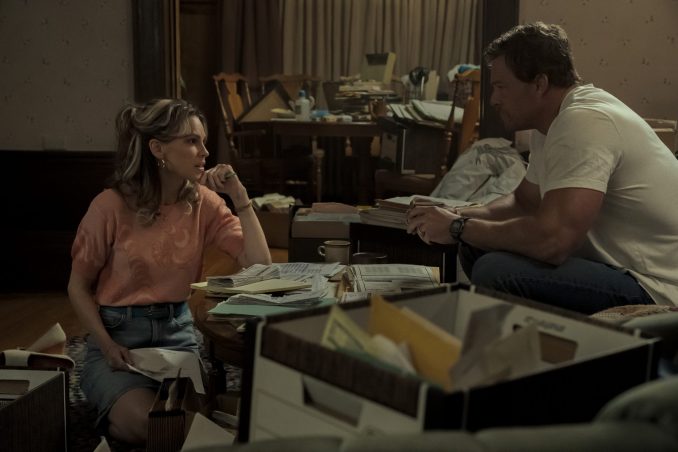 ORDINARY ANGELS have genuine


 The documentary is by turns uplifting and shattering. Most powerfully, it is a stark reminder of the human costs of ongoing Russo-Ukrainian war. Unbelievably, this week will mark 2 years since Russia’s invasion and escalation of the conflict. While the war may not be at the forefront of the public conscious in 2024 to the same degree as it once was, it remains a constant for the staff and families at Veselka. This is not an overseas battle for them – these are their loved ones and families fighting and dying while the world moves on to the next crisis.


 The film takes place in a single location where The Interviewer records her podcast. The secluded and expansive modern mid-century estate allows her to wander, but most of the action happens at a desk or in front of the wall of windows that contain her discoveries. Our journalist creates an episode of her first phone calls. Editing the calls at her will, the audience questions her culpability. This small moment puts your morality compasses in a tailspin. It is a slick move from writer Lucy Campbell. Podcasts are my nightly ritual, cleaning motivation, and my travel companion. Since SERIAL, the industry has exploded. In MONOLITH, the story goes viral. People begin contacting her directly with their stories, always warning her to stop.
 At some point, the danger reaches the front door of our journalist’s secluded location when she receives a package related to the mysterious story. The darkness attached to the object feels slightly Faustian and not of this planet. No one remembers how they received their object, but each reaches a point in questioning where they feel compelled to hang up out of fear.
 Is this a case of mass hysteria? In many ways, the plot mirrors today’s conspiracy groups like QAnon. Our leading lady goes down the rabbit hole, and the audience follows. MONOLITH boasts a jaw-dropping final ten minutes. This is one hell of a sci-fi thriller. It is a must-see.


 On-the-ground video from January 6th, up close and personal from cell phones, retraumatizes the viewer. The new footage is mind-boggling and will undoubtedly fill you with rage and disgust. The film features sociologists, authors, historians, lawyers, and pastors. We examine the Constitution and the precise articles requiring separation of church and state. We look at evolving statistics on social issues through the years. The interconnectedness of women’s rights, race, and power is undeniable.
 Violence as a means of “spiritual defense” comes directly from the pulpit over and over. The film effectively builds towards January 6th by wading through the madness swirling in the years prior. It is utterly bewildering and 100 percent terrifying. This coordinated effort to keep people in a cult is deliberate and well-funded. History repeats itself. Wait until you find out the architect of Evangelical sermons.
 GOD & COUNTRY keenly explores the long history and bastardization of Christianity through White Nationalism. It is a political movement about power. America is a ticking time bomb encouraged by social media, media, and billions of dollars. Stay vigilant and show up at the polls because democracy depends on it.


 Cleverly choreographed camera work by Aurel Ganz makes us think the film is one long take. Just as impressive is the actual shot list. 28, to be exact. It is one hell of a visual feat. The flip side of these takes is the narrative feels draggy even at 110 minutes. The sci-fi element does not seem necessary to the plot. Ultimately, it goes nowhere.
 Performance is solid from our four main leads, each one bombarded by misogyny, judgment, and outright hateful behavior. LAST PARTY might be more successful as a series. There is much needed in character development, although the breadcrumbs are there. It feels more like a treatment for a larger project than a stand-alone piece.


 Authentically hilarious, audiences get to know Nellie through a series of sexual romps, engagement parties, weddings, baby showers, and pregnancy panic stories. The inundation of opinions and horror stories sounds familiar to me. I got pregnant at 35 and 36, so, naturally, I was deemed a “geriatric.” The combination of rage and fear was no joke. Leah McKendrick nails the ups and downs of that stage of life. It’s an existential crisis that you only truly understand if you’ve experienced it firsthand.


 Mort and Michelle’s dynamic feels incredibly forced. The dialogue is a bizarre mix of awkward bad jokes and deeply personal romantic words. It is a baffling mix. The story is a mess, and there are innumerable superfluous scenes. The pace is glacial. At an hour and fifty-six minutes, this could have been eighty minutes at the most.
 The most successful aspect of the film is Eric Roberts‘ soothing narration, but there are too many inconsistencies for the final twist to go down smoothly. This is one of those times where a flashback montage of all the clues would greatly benefit the film.


 Kate Lyn Sheil (
 My love for Scott Haze knows no bounds. From his breakout performance in
 The ominous score by Tristan Bechet sometimes grates in a way that makes you subconsciously cringe. The continuous low din instills pure fear. Stay through the entire end credits for more eerie ear candy. THE SEEDING has echoes of The Hills Have Eyes horror and Midsommer folklore. All said it is an upsetting watch, and that’s what genre fans show up for.


 The documentary follows Tina Cordova as she advocates for herself and her fellow “downwinders.” Downwinders are innocent bystanders who may have suffered negative health effects from the Trinity test – the 1945 detonation of a newly developed nuclear weapon in New Mexico.
 The anecdotes from the immediate aftermath of the nuclear test are truly horrifying. One particularly striking recounting involves children playing with what they thought was “warm snow, but may have actually been nuclear fallout. Still more disturbing is the potential generational effects of the test. There are recounts of stillbirths, of children born without eyes, and of widespread cases of cancer across the affected communities. Cordova herself is a thyroid cancer survivor, the 4th generation in her family to have cancer since the test in 1945.


 We witness the tragic evolution of Curtis’ extended family through intimate sit-downs with family members, sharing their darkest secrets without a moment of hesitation. Their goal is equal parts redemption and cathartic confession. Some family members try harder than others, though the dark thoughts never leave. Religion lands somewhere between true belief and crutch. Mostly, the latter.
 Thoughtful closeups and the hauntingly beautiful score create heartwrenching transitions. Moyer and Toensing try to offer moments of childhood levity featuring Curtis and his siblings playing with poppers, water guns, and video games, but lurking in the background is the reality of parents severely impaired by drugs. Inheritance breaks your heart. A six-year journey down a rabbit hole of repeated histories. Is Curtis the best bet to break the cycle? One can only hope.


 Political spin can make or break a campaign. Those few who possess the skill have the power to command entire nations. In the Bloomquist Brothers’ latest film, FOUNDERS DAY, a small-town mayoral race brings chaos in the form of a serial killer dressed as, you guessed it, a twisted Founding Father straight out of a cliche painting of the signing of the Declaration of Independence. As members of the town of Fairwood get knocked off, one by one, the race is one to find the killer and their ultimate motive. Tackling every political hot-button issue and tactic with a bucket of gore, FOUNDERS DAY is here to mix things up.


 TIME BOMB Y2K makes terrific points about the effects of technology on human interaction. The film delves into how certain groups of people reacted during the unknown. Some folks became preppers, while others cried “Hoax” from the beginning. It’s a perfect metaphor for the power of disinformation, closely mirroring how a particular subsection of alt-right people think a homegrown militia uprising is coming. I had no idea this existed in preparation for Y2K. We have to take into consideration how the world reacted during COVID. The potential for violence equals the potential for peace. It is a fine line.


 Twin brothers Tristan and Làzaro are aspiring astronauts. During a late-night swim, Tristan becomes infected with a mysterious physical and mental ailment when a bright green asteroid plummets into the water. Lazaro must understand his brother’s drastic changes as he tries to maintain an elite physical and psychological state.
 Marta Nieto plays the twin’s mother, Mayra. Her performance is like a gut punch. Writers nail the invisible labor and isolation in motherhood and its inevitable breaking point. Nieto lives in the skin of Mayra and earns a standing ovation. Pablo Cobo and Loius Peres are magnificent. Cobo’s brooding anger equally matches his deep adoration for his twin. His performance as Làzaro is an emotional roller coaster, riddled with survivor’s guilt. Peres leans into palpable fear and trauma, giving audiences a complete 180 in physicality. TROPIC’s costume and makeup departments lend a hand here as they switch gears for Tristan from tailored clothes to ill-fitting outfits, as well as his elaborate facial fx. He is spectacular.
 As a special needs parent, this is a brutal but honest watch. Feeling “othered” as an individual and a family is viscerally devastating. The cinematography, particularly the underwater footage, is mesmerizing. The sci-fi elements combined with a perfect synth score create a timeless feel. TROPIC defies a single genre category. The volatility of this unique story is riveting, but its gravity lies within its intimacy.

 FREUD’S LAST SESSION

 Liv Lisa Fries delivers a stunning performance as Anna Freud, Sigmund’s intellectually accomplished daughter. The complexities of the role will undoubtedly touch a nerve with many viewers. Fries navigates the character splendidly. Matthew Goode plays C.S. Lewis. Coming to Freud for an impromptu therapy session, the audience learns about his childhood and the inspiration for his creative spark of genius. Goode effortlessly matches Hopkins’s energy. He once again establishes himself as a go-to casting choice. His raw vulnerability is captivating. Sir Anthony Hopkins remains at the top of his game. As Freud, he brings curiosity, wit, and curmudgeonly stubbornness all at once. It is yet another notch in Hopkins’s impressive career belt. This ongoing tennis match of masterful acting is perfection for historical drama lovers.
 The cinematography and production design are luscious. The editing is lovely. Freud moves about his home, passing through doorways only to be transported through time and memories. Meaningful flashbacks fill the screen as each man shares their intimate history beginning in childhood and explores how it informed their development. The script, alongside the editing, has a dazzling theatricality. This makes more sense once you learn the screenplay was based on Mark St. Germain‘s play, adapted for the screen by Germain and director Matthew Brown. A West End production of FREUD’S LAST SESSION would be delicious. The references to literary figures and quotations are smirk-inducing for the well-read audience, while the overarching existential volley proves delightful.


 Coming home for the holidays is always wrought with complex emotions. Directors Caroline Keene and Dan Kennedy give audiences much to ponder in MERRY GOOD ENOUGH. A film about familial chaos across generations, this enjoyable small-town film is sure to strike a chord this holiday season.
 Joel Murray is George, the absent but immensely excitable father figure. Writer-director Caroline Keene drops early hints of his toxic masculinity, and Murray eases into the skin of a pretty loathsome man. Daniel Desmarais plays Tim. His sardonic wit meshes perfectly with this cast of fantastic misfits. Comfort Clinton is Cynthia. She is uptight and controlling. Clinton owns the role with her evident daddy issues and needs for approval.
 Sawyer Spielberg is charming as neighbor Sam. His chemistry with Levine is magic, which makes sense since they’ve been married since 2018. Susan Gallagher‘s performance is spectacular. Keene’s script nails the mother of adult children vibe with running errands, asking if we’ve eaten, awkwardly using technology, grabbing coffee, and the overly stocked fridge. Gallagher captivates with her vulnerability. Raye Levine gives Lucy a tangible relatability. She’s funny, a little lost, and yet entirely grounded.
 At the heart of MERRY GOOD ENOUGH, this script delves into unresolved childhood trauma, emotional isolation, mental health, and forgiveness. It’s a breezy watch about finding bliss and connection in the imperfect.

You must be logged in to post a comment.