
 RESTORE POINT
It’s the year 2041, and humanity has reached the point where it can cheat death. Anyone who dies an unnatural death has the right to be brought back to life. All you have to do is to create a backup of your personality – a restore point – at least every forty-eight hours. But there exists a movement of people who try to sabotage this concept. “Agent Em” finds herself drawn into a case that is not as simple as it first seemed and the consequences of which reach to the highest levels of politics.
A wildly original premise and magnificent worldbuilding send Fantasia audiences headfirst into Robert Hloz‘s sci-fi crime thriller RESTORE POINT. It is 2041, and citizens have gained the right to resurrection if they die an unnatural death, as long as they have backed up their personalities and memories within 48 hrs. This information remains in the cloud. Following the murder of one of the lead scientists and his wife, a detective with a vendetta comes on board to discover corruption on every level.
I kept thinking about the franchise potential of this story. RESTORE POINT’s visual epicness from production designer Ondrej Lipensky is stunning. More reminiscent of Total Recall and Minority Report and less punk rock neon than Blade Runner. Aside from the overarching and mind-blowing plot device, it feels like a logically progressing technological surrounding. Costuming is beautifully subtle, punctuated by small angular details, predominantly around the collars and tailoring.
 Matej Hádek plays David with an intentional glitchiness. The physical and emotional choices draw you into the mystery. Andrea Mohylová brings humanity that grounds her performance. You can see the gears turning, the struggle between the personal and principles of the case. Mohylová is badass, effortlessly carrying the action. She is extraordinarily watchable. As a duo, they are inarguably compelling.
The film is a commentary on automation and morality, progress, and profitability. It makes you think. It is a carefully crafted tale filled fueled by both greed and the greater good of humanity. RESTORE POINT will wow Fantasia 2023 audiences, forcing them to answer more than one “what if” long after the credit roll.


 Both films also ask complicated questions surrounding the way ideals or symbols exist or endure once they are exposed to the whims of the broader world. When Barbie and Ken leave Barbieland, they quickly learn that what they believed to be universal truths no longer apply. The way they see themselves may not be how others see them. Similarly, an initial vision for how the atom bomb might be leveraged quickly shifts when the weapon rolls out of the lab and into the hands of the US military. Both Barbie and Oppenheimer are forced to realize that intention doesn’t necessarily translate to reality.

 The dizzying camerawork from cinematographer Rui Poças and ominous original music from Shida Shahabi raise the hairs on the back of your neck. Sharp sound design by Branko Neskov, which includes podcast audio, is a clever device. As a National Park After Dark fan, this was a slick addition to Sutherland’s narrative style. Editor Alexander Amick furthers Lennon’s isolation amid flashbacks and ghoulish visuals that muddy the lines of reality. It is the ultimate manipulation. All of these elements come together for an atmospheric stranglehold of fear. LOVELY, DARK, AND DEEP holds you tightly, only momentarily loosening its grip for minutes at a time. With a script that keeps you guessing at every turn, Fantasia is a uniquely crafted atmospheric journey into psychological terror.

 The narrative flips when Katya becomes entangled with the son of the laptop owner. Her online sleuthing would put the cops to shame. It is millennial cyberstalking at its best. Liza Zaitseva gives a heart-stopping performance as Katya. Her relentless emotional investment is a rollercoaster ride. She is simply magnificent.

 Joseph Castillo-Midyett and Ella Rae Peck are a great team as the local cops. Their scenes together are a welcome break. Marshall Bell plays Hammond as the wealthy town villain with the precise amount of elitist disdain we need. Alex Hurt plays Charley with a passion and relentless do-gooder attitude despite his surmounting inner turmoil. His physical work is magnificent. He has a strangely calming presence, even through his sullen outlook. I could watch him all day.


 The teenage shenanigans ring true. That feeling of invincibility and daring remind me of my crazy ideas and dumb decisions in the late 90s. Egghead and Twinkie take risks, make mistakes, hurt each other, get their hearts broken, and confess their fears. The film is a helpful guide for parents struggling to understand their kids’ feelings. Regardless of their core beliefs,

 Paiffe


 Isaac Jay is Dan. He delivers the right amount of good-guy energy topped with the typical carefree male partner. His tonal shift between Eliza and KJ will rub you raw. His patience is vital to Glue Trap’s success.
 To find out more about DWF: LA,


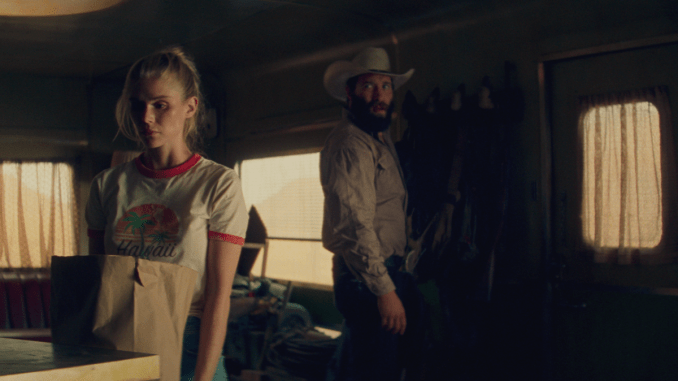 Sunset in the desert. A modern mobile home splashed with paint, the bold hues almost glowing in the half-light. A man with a rifle. A shrill scream. Stuart Gatt’s Catching Dust announces itself by beginning with these enthralling moments. A film centering on a painter, it is interested in the motivations of its character, but also in placing them as figures within beautiful tableaus. The cinematography is gorgeous – there are shots in this film that could be framed and hung on your living room wall.

 Barbara Crampton, whom I retain the right to declare a Time Lord, plays Dr. Danielle Upton. Had this film been made 20 years ago, she would be Beth. Crampton is as good as it gets. She’s sharp, 100% committed, and slyly comic. Her casting is no accident, and writer Dennis Paoli (Re-Animator) again does her justice. Judah Lewis plays Asa like a pro. His ability to switch characters and match Graham’s energy is astounding. I think it is legitimate to call him a Scream King by now. Graham goes all out, essentially playing three roles in one. She’s feisty and unbridled. Easily keeping up with Crampton’s iconic status, Graham nails the style.

 Luke Evans plays Nicky with a workhorse attitude that comes off as dismissive and arrogant against Billy Porter’s caregiver grace. This dynamic rings authentic for me as the default parent in my marriage. Porter nails every aspect, from his sing-songy tone of voice with Owen to the hesitancy to speak up for his emotional needs. Seeing myself on screen hit hard. While I’ve not had to go through divorce and custody dynamics, I have had these “come to Jesus” moments with my husband. I’ve been lucky.


 In the fall of 2021, filmmaker James Gallagher rode across the country with Marc Rebillet on his sold-out Third Dose Tour to capture what it was about the artist, showman, and robe-clad musical alchemist that brought thousands of people out of their homes for the first time.


 Young Je’Vida comes to life through the eyes of Agafia Niemenmaa. This personification of innocence is captivating against the stark quiet of Finnish snow and ice. She is a star. Sanna-Kaisa Palo gives present-day Lida a palpable lived-in trauma and definitive rage. Dismissive at the beginning, her healing journey comes with the shedding of shame and reclamation of identity through the next generation.

 Jennifer Kim plays Meg with frayed nerves and pent-up trauma on every inch of her skin. She lives inside the mind of someone who survived unspeakable horror. But, her feisty spirit and take-no-shit attitude barrel this unrelentingly intense story onward. Kim owns every second of screen time.

 Troy’s vulnerability flows off the screen. Reenactments directly from Troy’s storytelling deliver every emotion possible. Have tissues on hand. It will be impossible to maintain a dry eye. I wept through this film, thinking about my child with autism. If I can be a fraction as supportive as Len Kotsur, imagine what Wes may be capable of achieving. In just over twenty minutes, this unforgettable film is an ode to a parent’s unconditional love.

 The moment Sav Rodgers meets Kevin, it’s fireworks. Kevin gives Sav access to everything the rest of us have always wanted to know. Smith confesses that Holden is him. The film plays through his lens, and much of the story comes from real people in his life. Some conversations are word for word. Just ask a close friend of Kevin and GO FISH screenwriter Guinevere Turner, who put much of herself into Amy when collaborating on the script.
  Joey Lauren Adams, who gives us the iconic performance as Alyssa, explains her power in the role through archival interviews and a sense from the film. Kevin was, perhaps, ahead of their time in featuring a strong bisexual woman. But, the biggest irony may be Joey’s truth about CHASING AMY. This pivotal interview changes everything for everyone. Both Kevin and Joey get into their complicated past with Harvey Weinstein. Their experiences are vastly different. I am so grateful for their honesty. It means so much to so many survivors. *Waves hands in the air*
  Intertwined with everything else in this glorious doc, Sav lets us into their relationship with his girlfriend, Riley. Delving into deeply personal issues, he may or may not realize how universal they are until now. One part fanboy film, another part film history, all self-discovery story, and a love letter to Riley, CHASING CHASING AMY is tailor-made for Smith fans and indie fans, the queer community, and allies.
You must be logged in to post a comment.