

HOME BODIES

Casey Walker‘s ceaselessly intriguing Fantasia 2026 film Home Bodies follows isolated twins, Blue and Red. Having solely existed in an automated environment, they experience a controlled perspective, from their color-coordinated tracksuits to their crayon packs and toys that only feature a variation of their assigned color. Each day, they find a VHS episode of a children’s television show called The Barn; something akin to a cable access version of the New Zoo Revue meets Neighborhood of Make-Believe.
But it is clear Blue and Red are different personalities. Blue is happiest with routine, in the way a young child aims to please to stay out of trouble. Red has more of a bored tween attitude. She has grown weary of the day-to-day. Red’s tedium leads her to momentarily lash out during a game of catch, breaking a window and disrupting their regularly scheduled actions.
Their only contact is “Papa,” a mysterious Hal-like speaker down a hallway. With a Speak-and-Spell tone of voice, the audience can hear faint keyboard tapping as the children report their error. When they wake to their version of Christmas morning, they discover they’ve been gifted an androgynous humanoid they name Pal. The arrival quickly drives a wedge between the siblings as Red’s attention has a fresh target.

When Red awakens to find Pal watching a bloody, slaughterhouse version of one of their television episodes, with a worse version arriving each night. Blue hatches a plan to get rid of Pal, but his actions immediately backfire. Red and Blue’s world begins to alter in small ways. Every regulated aspect of their lives starts to glitch, from the water and food quality to temperature settings, garbage disposal to communication, pitting the siblings against one another.
Ian Ho‘s Blue is almost punchable, which is a total compliment. A stickler for rules and equally bratty creates an incredibly compelling performance based solely on self-preservation. Emma Ho gives Red a feisty air that beautifully counters Ian’s underdeveloped social-emotional state. Her daring non-compliance and knowledge-seeking provide a healthy perspective for the audience to grasp onto. Their chemistry is magic.

Home Bodies feels like Ray Bradbury‘s The Veldt meets a daylight version of Skinamarink. The cinematography is fantastic. Bryn McCashin utilizes security camera angles and peculiar POV shots from inside trashcans or the microwave.
Chareese Steinhoff‘s production design is immersive. The aging midcentury aesthetic of the automated house is unnerving. There is a recurring theme of dripping water, from the faucet, the shower, pipes, down walls. As consequences loom, it almost feels as if the house is slowly disintegrating.

Home Bodies is unbelievably entertaining. There is never a dull moment. Adrian Murray and Marcus Sullivan‘s script explores the fallout of violating trust and broken rules; it is a sinister evolution of manipulation, and perhaps a metaphor for today’s youth and their reliance on technology to regulate their needs. Home Bodies boasts a mind-blowing finale that makes it ripe for a franchise. I have all the questions, and I am begging for more. Do not move during the credits. The moment the film ended, I started it again and gasped. Oh, the breadcrumbs.
World Premiere Screening
HOME BODIES
Thursday, July 23, 2026
9:30 PM
Cinéma du Musée
Fantasia International Film Festival
Presented in the Septentrion Shadows section
Presented with the short film SLEEP THROUGH SUMMER


![Holo - 2026 Tribeca Festival - Tribeca - [tribecafilm.com]](https://i0.wp.com/reelnewsdaily.com/wp-content/uploads/Holo-2026-Tribeca-Festival-Tribeca-tribecafilm.com_.png?resize=678%2C383&ssl=1)
![Zelda Williams in HOLO_[JULIAN LOMAGA]_20](https://i0.wp.com/reelnewsdaily.com/wp-content/uploads/Zelda-Williams-in-HOLO_JULIAN-LOMAGA_20-scaled.jpg?resize=678%2C367&ssl=1) Shane West, heartthrob to a generation of women like me thanks to A Walk To Remember, still exudes an effortless charm that leaps off the screen. As Jared, he taps into a terrifying rage. Morgan Kohan gives Claire every bit of herself. It’s the arc we die for. Bravo to Zelda Williams for playing Jared’s human counterpart (more of her, please), and to director Alexander DeSouza and Ashley Brandon for the seamless editing. Magali Lafeur nails the production design.
Shane West, heartthrob to a generation of women like me thanks to A Walk To Remember, still exudes an effortless charm that leaps off the screen. As Jared, he taps into a terrifying rage. Morgan Kohan gives Claire every bit of herself. It’s the arc we die for. Bravo to Zelda Williams for playing Jared’s human counterpart (more of her, please), and to director Alexander DeSouza and Ashley Brandon for the seamless editing. Magali Lafeur nails the production design.![Morgan Kohan in HOLO_[JULIAN LOMAGA]_5](https://i0.wp.com/reelnewsdaily.com/wp-content/uploads/Morgan-Kohan-in-HOLO_JULIAN-LOMAGA_5-scaled.jpg?resize=678%2C367&ssl=1) DeSouza creates an ominous atmosphere. Screenwriter Alexander Hernandez-Maxwell pulls on our darkest desires and intrusive thoughts. Fans of Severence, Westworld, and the 2024 doc,
DeSouza creates an ominous atmosphere. Screenwriter Alexander Hernandez-Maxwell pulls on our darkest desires and intrusive thoughts. Fans of Severence, Westworld, and the 2024 doc, ![Shane West In HOLO_[JULIAN LOMAGA]_32](https://i0.wp.com/reelnewsdaily.com/wp-content/uploads/Shane-West-In-HOLO_JULIAN-LOMAGA_32-scaled.jpg?resize=678%2C367&ssl=1)
 For more Tribeca 2026,


 This heartwarming doc has some amazing personalities. Audrey is Sound. Her infectious wonder is the epitome of SILVER SCREAMERS. David is Special Effects. With his puppeteering skills, the film’s villain comes alive. Diane is in charge of Makeup. Her theatre background is key to her role. Sonny is the Camera Operator. He is reactivating the dreams of his youth.
 The team takes on their jobs with a refreshing enthusiasm. Watching each one tackle their assignments is like a boot camp into the complexities of filmmaking. Editor Lee Walker delivers an incredibly engaging montage of their initial endeavors. The opening credits are integrated into the film’s storyboards. It’s a brilliant device.
 SILVER SCREAMERS acts as an advocacy pitch for art therapy at every age. Wait until you hear the ADR session. It’s a riot. The horror homage final scene is the cherry on top. Fantastic Fest audiences are in for a real treat.
 For more on Fantastic Fest,

 Based in part on her 2017 film BIRTH OF A FAMILY, Tasha Hubbard brings her scripted narrative debut to TIFF 50. MEADOWLARKS stars Michael Greyeyes, Carmen Moore, Alex Rice, and Michelle Thrush as four Cree siblings who were separated by the Sixties Scoop, who are meeting for the first time as adults.
 Performances are fantastic. Each character is incredibly nuanced. Four siblings with varying goals for the trip and vastly different personalities. But what links them is far deeper than the ways in which they were raised by white families.
 For more TIFF coverage,


 A father wishes to compliment the chef for his signature dish, only to discover that an actual shrimp is responsible for the deliciousness. In this mockumentary-style short, The Shrimp insinuates that his entire schtick was stolen by the Disney rat. The two then compete on a food competition reality show. The producers secretly chat with the man under The Shrimp, Chef Dave. Shrimp is a foul-mouthed asshole, for lack of a better word. Shenanigans ensue, confessions reveal themselves, and insults fly.
 There are multiple Shrimp puppet creations. The smaller version sits on Yung’s head, and a larger-scale handheld puppet fills the screen for the sit-down interviews. The detail is award-worthy. Puppeteers Benjamin Fieschi-Rose, Kirsten Brass, and Amelia Blaine are spectacular.
 For all things Fantasia,

 The consequences of going down that rabbit hole, sometimes literally, are a barrage of repressed childhood memories and the instability of her mother’s treatment. Mia’s trips reveal a trauma monster, more specifically, one made of mom’s blond locks. This hair monster torments Mia throughout her jacked-up journey.
 Caitlin Acken Taylor is everything. Mia Sunshine Jones is no easy role, but Taylor lives it. She even creates Mia’s paintings and sculptures. Her fourth wall break, and the precise moment at which it occurs, is jarring and genius.

 After a bus ride on her way out of town gets cut short by a sighting of her local crush, Cleo’s infatuation becomes a way of life that maybe isn’t what she intended. Her mother, Lady Andre, comes looking for her and mistakes a passing moment for the end of her legacy.
 Jessica Paré delivers a vivacious performance as Lady Andre. She is eccentric and demanding, but is undoubtedly battling unresolved wounds. Skylar Radzion is Josephine, the hairless sibling in the bearded family. She is a spitfire and a slick foil for Cleo.
 PINS AND NEEDLES
 Filmmaker James Villeneuve brings audiences a creative thriller ripped straight from global science and technology headlines. In PINS AND NEEDLES, a diabetic biology grad student’s ride back to campus turns deadly when a flat tire finds her trapped with two diabolical biohackers. With her insulin running dangerously low, Max must figure out a way to escape and take down a couple of psychopaths in the process.
 Max’s diabetic hallucinations are an incredibly creative way to use Daniel Gravelle and work out potential escape routes. Short and sweet fantasy sequences also keep your heart racing. I would have loved more of both. I do have a gripe about there being no food in the house. Emily and Frank very clearly live in the house, and there is not a single snack lying around.
 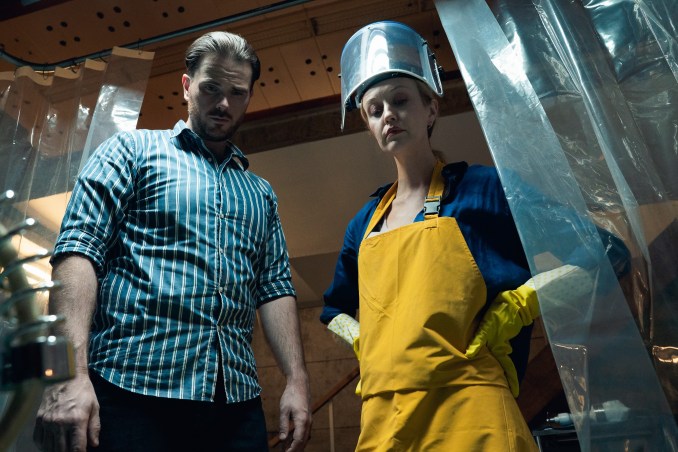 While Kate Corbett and Ryan MacDonald are sufficiently eccentric and evil as our whackjob “scientists,” PINS AND NEEDLES is 100% the Chelsea Clark show. She easily carries every scene with grace and ferocity while never going overboard. She is one to watch.
 I loved the use of car keys, and women will cheer that shit on. Did I yell at the screen during the finale? Damn right. PINS AND NEEDLES makes direct fun of billionaire Bryan Johnson. You know, the guy injecting himself with his son’s blood to stay young forever. And, just for your information, he’s moved on from that practice and opted for a “total plasma exchange” instead. Biohackers love to claim science when we all know damn well any fountain of youth is only for sale to the highest bidders. PINS AND NEEDLES leans into real-life monsters in a wildly clever way.

 Life Coaching has become a rather broad term in our culture, akin to “Wellness.” Director Annie St-Pierre explores the various methods in her SXSW 2025 film YOUR HIGHER SELF. Everyone is looking for enlightenment, even if it means wading through the good, the bad, and the ridiculous.


 Stories from staff, families, and residents tell tales of daily transgressions that build over time, ranging from laundry, food choice, incontinence care, medication changes, falls, and worker burnout due to understaffing. The film utilizes beautiful, childlike drawings as transitions and storytelling devices. Cell phone videos of neglect will break your heart. Photos of resulting abuse may take your breath away.
 Then COVID-19 and 2020 made things so much worse. Once their failures are exposed, the government protects nursing homes from lawsuits sighting the pandemic and loss of workers. In each case, once regulations appear, they apply only to staff and never to the corporations behind the individual homes. These workers are the essential piece of the puzzle between a new standard of care and honoring their relentless efforts to do the right thing. The film delves into racism, the reductive overview of the profession, the label “women’s work,” and how simple changes would make all the difference.
 The corporate lawyers use vile tactics to diminish their role, often attacking the family members with shaming language. Melissa explains this by giving her clients mock cross-examination examples to emotionally prepare them for what is coming in litigation. Another way they try to determine litigation is to delay and then drown Melissa and her team in documents. By giving her the runaround, they hope she will give up. They don’t know Melissa Miller.
 The personal connections between legislation and privatization will shock no one. STOLEN TIME lays it out for you. The systemic failure, profit over people, no regulatory oversight, long-term residents are unnecessarily suffering. STOLEN TIME is about accountability and justice. The goal is an overhaul of the system. When we say long-term care, the keyword should still be “Care.”


 For more TIFF 2024 coverage
 RED ROOMS

 Juliette Gariépy initially gives Kelly-Anne a quiet ferocity. Assume nothing about the character as she slowly reveals her sleuthing skills. Gariépy morphs into a startling presence, with each consecutive scene getting under your skin. Gariépy is disturbing.
  The juxtaposition of her photoshoot stills and those of security camera suspects is undeniably clever mirroring. Once the infamous video plays, the decision to focus on our protagonist and not the most gruesome acts almost makes the plot more invasive. The combination of the audio and your imagination causes you to turn away. Kelly-Anne’s skills keep her on a tightrope. One missed step, and the bottom drops out.
  The script is far more nuanced than at first glance. Plante delves into technology, the female fascination with true crime, and the repercussions of unresolved trauma. The more Kelly-Anne shares with Clementine, the more unsettled the audience. As a parent, RED ROOMS is a visceral viewing experience. It is simultaneously rage and despair-inducing. As a mother, putting that hat aside, as difficult as that may be, the film is indisputably brilliant storytelling. The hideous twists keep coming. RED ROOMS will hold you captive, whether you like it or not.


 Kim Ho-jung is magnificent. Sara’s journey spans motherhood, friendship, sleuthing, romance, and identity. Ho-jung embodies silliness, anxiety, boldness, and worldly naivete. She masters each moment with ceaseless charm. She is a star.
 CLOSE TO YOU
 CLOSE TO YOU
 CLOSE TO YOU

 Montreal-based comedy duo Emelia Hellman and Nancy Webb (Hellgirl Productions) bring their paranoia-fueled short Bangs to Fantasia Festival’s Fantastiques week-ends du cinéma québécois this summer for the film’s Canadian premiere.


 Desperate to keep her promise to host the best superhero party for her 6-year-old, young mother Sid, a sex worker, takes extreme measures and books a last-minute client with a dark fetish. Dirty Bad Wrong is a drama/body horror that explores the darkest sides of capitalism, and just how far we’ll go for the ones we love.
 Life changes when you become a mother. It is impossible to describe to someone who has never protected another human with every ounce of their soul. In
  Jack Greig
 For all things Fantasia 2024,


 Someone seems to be leaving Miriam cryptic notes and clues connected to her life. A kind-hearted and observant Toronto librarian at a quiet branch filled with an eclectic group of patrons,
  Britt Lower
You must be logged in to post a comment.