GRIMMFEST turns lucky 13 for this year’s hybrid addition. Here are some of the films we’re screaming about.

GRIMMFEST 2021

It’s no secret that the most buzz-worthy films come through only a handful of genre festivals. GRIMMFEST is on that shortlist. The festival turns a lucky 13 this year and it’s ready to rock audiences’ socks with a plethora of titles for every single viewer. After being completely virtual last year, a hybrid platform is back in action with a mix of in-person screenings from October 7th to 10th and online from October 14th to 17th. I can say that this year’s lineup is filled with everything from gore to absurdity, thrills to purest moments of wow. These are the films that will be on everyone’s lips. You can find out about tickets and schedules at https://grimmfest.com/

Do yourself a favor and mark your calendars now. There’s a lot to see.


THE BETA TEST

A Hollywood agent, engaged to be married in a few weeks, receives a mysterious letter inviting him for an anonymous sexual encounter and thus becomes ensnared in a sinister world of lying, infidelity, and digital data.

This genre-shattering film takes aim at Hollywood, toxic masculinity, horror, satire, all with co-writer-director Jim Cummings playing a sharp lead. His last film, The Wolf Of Snow Hollow, has a legit cult following now. Cummings has a distinct voice and I cannot wait to see if The Beta Test becomes another calling card on his resume.


THE RIGHTEOUS

A burdened man feels the wrath of a vengeful God after he and his wife are visited by a mysterious stranger…

There is something so striking about modern black & white cinematography. in The Righteous, writer-director Mark O’Brien also stars as the mysterious stranger in question. This horror film is filled with symbolism and will give any god-fearing viewer the vapers.


WHEN THE SCREAMING STARTS

When the Screaming Starts is a comedy-horror mockumentary about an inept, aspiring serial killer at the beginning of his “career” and a fledgling filmmaker willing to do anything to achieve his ambition.

A little bit of Vicious Fun meets Satanic Panic, I cannot wait to laugh and gag. Horror and comedy pair so well together and since everyone is a true-crime connoisseur who thinks they could commit the perfect murder, I am delighted to consume this one.


THE SPORE

The lives of ten strangers intersect through a terrifying chain of events as a mutating fungus begins to spread through a small town wiping out everyone that comes into contact with it.

Will this film be a little too close to home considering we’re still experiencing a global pandemic? I guess we’ll find out when we’re forced to look through the lens of writer-director D.M Cunningham.


HOTEL POSEIDON

Dave inherited the dingy and dilapidated Hotel Poseidon from his late father. He lives there and works as manager, and rarely seems to leave the place. The days and nights all bleed together. His existence is a hopeless one. When a young woman knocks at the hotel’s doors one night looking for a room, and his best friend shows up wanting to throw a party in the backroom, Dave’s world starts to spiral out of control, and his sense of reality starts to be shaken by recurring nightmares.

I have seen the title sequence for this film and it is hands down one of the coolest in all of cinematic history. I said what I said. If the rest of the film lives up to the initial visual, Hotel Poseidon will wow Grimmfest audiences.


ALONE WITH YOU

As a young woman painstakingly prepares a romantic homecoming for her girlfriend, their apartment begins to feel more like a tomb when voices, shadows, and hallucinations reveal a truth she has been unwilling to face.

Listen, you tell me Barbara Crampton is in a film and I’m watching it. Add on Emily Bennett who was fantastic in King Of Knives last year and I’m sold. Not only does she star, but she co-wrote and co-directed the film. Give me an all-female horror film every day of the year.


FULL VIRTUAL FESTIVAL LINE UP:

● FOR ROGER (Aaron Bartuska, USA)

● FATHER OF FLIES (Ben Charles-Edwards UK / USA)

● SLAPFACE (Jeremiah Kipp, USA)

● THE NIGHTS BELONG TO THE MONSTERS (Sebastian Perillo, Argentina)

● HAPPY TIMES (Michael Mayer, Israel / USA)

● NIGHT AT THE EAGLE INN (Erik Bloomquist, USA)

● VAL (Aaron Fradkin, USA, 77 min)

● THE SPORE (D.M. Cunningham, USA)

● THE PIZZAGATE MASSACRE (John Valley, USA)

● MOTHERLY (Craig David Wallace, Canada)

● SHOT IN THE DARK (Keene McRae, USA)

● NIGHT DRIVE (Brad Baruh, USA)

● MIDNIGHT (Oh-seung Kwon, South Korea)

● FACELESS (Marcel Sarmiento, USA)

● WE’RE ALL GOING TO THE WORLD’S FAIR (Jane Schoenbrun, USA)

● THE FREE FALL (Adam Stillwell, USA)

● ON THE THIRD DAY (Daniel de la Vega, Argentina)

● THE GUEST ROOM (Stefano Lodovichi, Italy)

● HOTEL POSEIDON (Stefan Lernous, Belgium)

● FORGIVENESS (Alex Kahuam, Mexico)

● TWO WITCHES (Pierre Tsigaridis, USA)

● KING KNIGHT (Richard Bates Jnr, USA)

● TARUMAMA / LLANTO MALDITO (Andres Beltran, Colombia)

● THE RIGHTEOUS (Mark O’Brien, Canada)


Passes and tickets can be purchased from www.grimmfest.com.

Review: ‘Small Engine Repair’ Explores Toxic Masculinity with Thrilling Effect.

SMALL ENGINE REPAIR

Frankie (John Pollono), Swaino (Jon Bernthal), and Packie (Shea Wigham) are lifelong friends who share a love of the Red Sox, rowdy bars, and Frankie’s teenaged daughter Crystal (Ciara Bravo). But when Frankie invites his pals to a whiskey-fueled evening and asks them to do a favor on behalf of the brash young woman they all adore, events spin wildly out of control. Based on Pollono’s award-winning play, Small Engine Repair is a pitch-black comedic drama with a wicked twist and a powerful exploration of brotherhood, class struggle, and toxic masculinity.


Frankie (John Pollono), Swaino (Jon Bernthal), and Packie (Shea Whigham) are working-class men that share a friendship bond going back to childhood. That bond is strengthened further by their co-parenting of Frankie’s beloved daughter Crystal, who has spent a lifetime being raised by a loving– if raucous– male collective. This sets the scene for a fascinating character study of a group of men raised in a culture steeped in toxic masculinity who struggle to push back against it but often fall incredibly short. 

At first, Small Engine Repair seems like a dark family drama with a comedic edge. However, it is not until the second act that the viewer realizes that they are in the midst of a thriller. Complex performances by the entire cast gradually build tension through sharp looks, quick words, and complicated histories until the atmosphere on screen is so thick with menace that suddenly, every word and movement is a threat. It is hard to say more without giving away the shocking twists that a seemingly ordinary whiskey-fueled night in a garage would unleash. So instead, I will say that the tightly directed and brilliantly acted Small Engine Repair had me holding my breath through the finale.


In Theaters September 10, 2021


Written and Directed by

John Pollono

Starring: Jon Bernthal, Shea Whigham, Jordana Spiro, John Pollono, Ciara Bravo, Spencer House


Dances With Films LA short film review: ‘CLASS’ deserves a standing ovation.

CLASS

SYNOPSIS: New student Max attends his first ever acting class. He soon discovers that the lines between class and cult begin to blur as he and his fellow students are subjected to the bizarre but brilliant methods of their eccentric teacher, Adam (David Krumholtz).


Is it possible writing and directing team Enzo Cellucci and Ash McNair videotaped my college years and then made a short film from the footage? From the looks of CLASS, the answer has to be a firm Yes. If you’ve never experienced an acting class, this short film might seem completely absurd. If you paid a ton of money to earn a degree at a conservatory, as I did, CLASS is also completely absurd. This is the highest compliment I can pay this guffaw-inducing short. It is a literal blueprint for acting class. Cellucci and McNair nail the aha moments that arise from notorious acting games. They capture the frustration and joy of workshopping a monologue.


While the success of this film hinges on the commitment of the spectacular ensemble, I must specifically salute Enzo Cellucci and David Krumholtz. The majority of the film revolves around Max remaining an observer. It is not until he is forced to participate that we are fully consumed by the heat of embarrassment only actors know in their souls. Cellucci’s emotional and physical beatdown creates greatness. As Adam, David Krumholtz is a goddamn character study in CLASS. It is everything, from the slicked-back hair, the robe over silk pajamas, and the pièce de résistance, the accent. The impeccably precise bastardization of a British accent is a thing of glory. If your ear is sharp enough, you’ll notice how it changes from scene to scene. It is, as they say, the chef’s kiss. CLASS is easily one of the most honest and cringeworthy shorts I’ve ever watched. I lived inside every second, and I loved it just as much. I’m still laughing. I am dying to see this developed into something bigger. It certainly deserves the audience. To everyone involved, Bravo!


CLASS had its WEST COAST PREMIERE AT
THE DANCES WITH FILMS FESTIVAL
IN LOS ANGELES WAS AT TCL CHINESE THEATRES ON FRIDAY, SEPTEMBER 3, 2021 AT 4:30 PM PT

CAST: David Krumholtz, Alina Carson, Enzo Cellucci, Amanda Centeno, Brendan Dalton, Kristin Friedlander, Carson Higgins, Joseph Huffman, and Ash McNair


DIRECTED & WRITTEN BY: Enzo Cellucci, Ash McNair


PRODUCED BY: Hank Azaria, Enzo Cellucci, Clea DeCrane, Karen Eisenbud, Srinivas Gopalan, Joseph Huffman, David Krumholtz, Jonny Marlow, Rob McGillivray, Ash McNair, Phillip Nguyen, Gayathri Segar, Ben Stranahan, Michel Tyabji

Dances With Films LA 2021 review: Brooke Trantor’s short film ‘Oh, Baby!’ really nails impending motherhood.

OH, BABY!

Oh Baby! a comedic narrative short done by Brooke Trantor and Kate Morgan Chadwick, and T.J. Linnard (Good Trouble) that follows Jane: a thirty-something pregnant woman having a baby on her own. Empowered, single, and horny AF she is determined to get what she wants tonight: sex, chalupas, and no strings attached. Enter Ben, a promising find from the world of online dating were he also has new options to find hookers near me.


This hilariously honest short film about love, sex, and impending motherhood is ripe for development. Having been pregnant twice, I understand how uncomfortable it can be. The cravings, both food and otherwise, can dictate every aspect of your day. What little control you have over your own time is about to run out permanently. Director Brooke Trantor co-writes the script with lead actress Kate Morgan Chadwick. Trantor understands how important the camera becomes as the intimate moments begin. Jack Lawrence Mayer‘s editing is just as important here. Trantor and Chadwick easily capture the humor and anxiety that come along with dating, in general. Heightening that concept with impending childbirth gives Oh, Baby! a modern twist. Kate Morgan Chadwick and T.J. Linnard have impeccable chemistry. I was completely enamored by them as the credits rolled. Charming and relatable, they are the perfect pair. I would love to see this story expanded into a feature. Dances With Films LA 2021 audiences will undoubtedly adore it, as well.


Dances With Films LA 2021 audiences can see Oh, Baby! September 4, 2021, at 1:30 PM

Review: IFCMidnight’s ‘WE NEED TO DO SOMETHING’ lets your imagination do a lot of the terrorizing.

WE NEED TO DO SOMETHING

After Melissa and her family seek shelter from a storm, they become trapped. With no sign of rescue, hours turn to days and Melissa comes to realize that she and her girlfriend Amy might have something to do with the horrors that threaten to tear her family – and the entire world, apart.


This is perhaps, one of the most batshit premises for a horror film I’ve seen in a very long time. That is one hell of a compliment. Innuendo sneaks in from the beginning, and while you can grasp Melissa’s guilt, never in a million years will you expect We Need To Do Something to unfold in the manner it does. That is the absolute genius of this script. Except for a handful of flashbacks, the entire film takes place inside the family bathroom. Terror arrives in many forms throughout this film. One of the most shocking is the progressive violence from Pat Healy‘s character, Robert. If you want to see a character study of epic proportions, Healy has got you covered. He begins as a disgruntled husband and selfish father, eventually succumbing to forces both inside and out. It’s a maniacal performance.
Sierra McCormick, who I believe was the best part of American Horror Stories, nails it again. Her anxiety is palpable, and she is unafraid to leave it all onscreen. If she isn’t the next genre darling, I’ll be shocked. The script does a great job of highlighting the awkwardness, the lack of privacy, and the growing tension under duress. Who wants to use the toilet in front of your family? Screenwriter Max Booth III provides us with a sharp left turn a third of the way in. The gasp and look of horror on my face must have been hideous. No matter how I assumed this story would play out, that one moment is so mind-blowing it will send chills down your spine. The film’s most impactful aspect is the sound. Man does this cast sell it. Your own imagination is your worst enemy while watching. The ambiguity lets every viewer come away with a different and twisted result. Director Sean King O’Grady has an undeniable hit with We Need To Do Something. Here’s hoping he and Booth team up again and again.

IN THEATERS, DIGITAL and VOD on FRIDAY, SEPTEMBER 3RD

Review: The an action-packed, visual feast ‘YAKUZA PRINCESS’ is in theatres tomorrow!

YAKUZA PRINCESS

Based on the acclaimed graphic novel “Samurai Shiro” by Danilo Beyruth and set in the expansive Japanese community of Sao Paulo, Brazil — the largest Japanese diaspora in the world — YAKUZA PRINCESS follows orphan Akemi (played by pop star MASUMI), who, upon turning 21, discovers that she is the heiress to half of Japan’s expansive Yakuza crime syndicate. After forging an uneasy alliance with an amnesiac stranger (Jonathan Rhys Meyers, History Channel’s The Vikings) who believes an ancient sword binds their two fates, Akemi unleashes war against the other half of the syndicate who wants her dead.


Part girl power, part crime drama, all revenge thriller, Vicente Amorim‘s Yakuza Princess has something for everyone. Action-packed with spectacular fight choreography, the pacing is super satisfying. Yakuza Princess is just cool. This ensemble cast is phenomenal. I want to see more of every actor, but I’ll focus on our two primary leads. MASUMI as Akemi is a spitfire. Her nonchalant power is striking. Then there is Jonathan Rhys Meyers (who never seems to age) playing the mysterious Shiro. He is such a brilliant foil for MASUMI. His ability to own the screen with but a glance is always magic. Together, their chemistry is ripe for a franchise.

Visually speaking, it’s a neon-soaked feast for the eyes. The use of light in this film is hypnotizing. It’s insanely thoughtful. Films like this are the reason we go to the movies. A LOT is going on in Yakuza Princess. This story is an epic journey. A complex family dynamic, murder, amnesia, kidnapping, a mysterious ancient sword all come into play in major ways. I would also have been delighted to watch this as a limited series. The drama! The plot twists! I was there for it all! It makes me want to run out and buy the graphic novel that is its source material. I demand its sequel, immediately. Pretty, please?


YAKUZA PRINCESS opens in U.S. theatres and virtual cinemas on Friday, September 3rd.

Review: ‘A WAKE’ is a powerful conversation starter for many families.

A WAKE

The children in a religious family clash with their parents as they prepare for the wake of their brother, Mitchel.


Growing up Catholic didn’t honestly impact me until 8th-grade. I should say that attending Catholic School didn’t make me feel any different until one specific religion class. It was a moment that changed my entire life. It was explained to me, that telling my mother I was gay would be the equivalent of telling her I had committed murder. That was a defining moment. Today, my mother lovingly refers to one of my younger sisters and me as her “heathen children.” I begrudgingly attended Christmas and Easter Mass with my family throughout my college years. Then I put my foot down. I would no longer perpetuate the charade. To put this all in extra context, I am a straight woman. I grew up in the arts, surrounded by some of the most extraordinary humans on this planet. I continue to defend equal rights and acceptance, despite pushback from too many. Films like Scott Boswell’s A WAKE are important for families who may not even know they are in crisis. This story offers acceptance and unconditional love as lifesaving tools.

Noah Urrea plays twin brothers Mason and the recently deceased Mitchel. The youngest sibling Molly is planning a memorial wake for Mitchel. Invitations are sent to older sister Megan, their grandmother, their Baptist pastor, and Mitchel’s boyfriend, Jameson. The boys’ father and stepmother are typical religious conservatives, touting blasphemy, a stiff upper lip, and an extremely toxic, “man up” tone. The majority of the family is in the dark about Mitchel’s life, and Mason is left to deal with the guilt and trauma of losing his brother. Secrets and sadness have a poisoning effect on a family. A Wake addresses them in an accessible way.

The cast is amazing. Each actor brings the energy necessary to tell this story with truth and realism. Some moments are awkward, while others are rage-inducing. Megan Trout, as older sister Megan, is great. She’s the voice of reason in all of the chaos, whether the other family members are ready or not. Kolton Stewart, as Jameson, is lovely. His quiet strength brings a calm to the sadness. Bettina Devin as Grandmother is a gem. She’s elegant and understanding. Sofia Rosinsky‘s neurotic mentality is a story unto itself. Through flashbacks, we can see a clear progression of her personality, her growing manic tendencies, and genuine curiosity. She’s a spitfire.

Noah Urrea gives life to two equally intriguing characters, Mason and Mitchel. He has star quality. His narration, and the accompanying camerawork and score, push A Wake to the next level. If I had to nitpick, because that score is so good, you notice when it doesn’t appear. The film would have benefitted from more music. At times, that silence consumed whatever dialogue was occurring, landing it into a hokey category. When everything came together, the culmination of A Wake does exactly what it’s meant to do. It tells a story of a family coping with the loss of their brother, their son, and their grandson. There are honest moments where chills happen. It’s wonderful storytelling and impactful LGBTQ representation.


Available on DVD & VOD: August 31, 2021

Cast: Noah Urrea, Kolton Stewart, Sofia Rosinsky, Megan Trout, Bettina Devin

Directed by: Scott Boswell

Written by: Scott Boswell


Fantasia International Film Festival 2021 review: ‘MARTYRS LANE’ is one of this year’s best.

MARTYRS LANE

Leah, 10, lives in a large vicarage, full of lost souls and the needy. In the day the house is bustling with people; at night it is dark, empty, a space for Leah’s nightmares to creep into. A small, nightly visitor brings Leah comfort, but soon she will realize that her little visitor offers knowledge that might be very, very dangerous.


I feared this Martyrs Lane would be overlooked among the plethora of gore-filled content. That would have been the biggest shame to befall this year’s Fantasia International Film Festival. Writer-director Ruth Platt‘s carefully crafted tension and mystery should be celebrated. It has a quieter Babadook energy to it that is unmistakable. The film manages to be both a slow burn and a vice grip of tension. The editing puts your head in a spin in that you’re never sure what is real until the very final scene. Performances are outstanding. The fact that the entire premise mostly hinges on the work of two small girls will blow you away. It is no wonder young lead Sienna Sayer won the Special Jury Rising Star award. Martyrs Lane will hit harder for parents. Any story centered around children begets that internal ache from the very getgo and Martyrs Lane is no exception. It’s beautifully shot and elegantly lit. The exquisite progression in makeup heightens the overall dread. It speaks to the consuming power of grief and secrets. I cannot wait for Shudder audiences to experience this film in a few weeks. This one is special. Undoubtedly, one of my favorites from this year’s lineup.


Martyrs Lane Streams Exclusively on Shudder on Thursday, September 9th

North America, UK, Ireland, Australia, and New Zealand


Fantasia International Film Festival 2021 review: ‘HELLBENDER’ rocked me to my core.

HELLBENDER

A lonely teen discovers her family’s ties to witchcraft.


Honestly, if I could choose to grow up in another family, it would be the Adams family. I’m not talking about Morticia and Gomez. While I adore that lot, I’m talking about the indie horror filmmaking family. These industrious and smart people consisting of Mom, Toby Poser, dad, John Adams, and daughters, Zelda and Lulu. Fantasia 2019 audiences got their first taste of spooky genius with The Deeper You Dig. It was scary, intense, unique, and then some. This year, Fantasia 2021 audiences got to experience a new tale of terror with Hellbender.

Their cinematography is stunning. They really understand how to fill a frame. Their writing feels collaborative. John Adams’ score is deliberate and insanely effective. The songs are so fantastic I would buy their album! Within the first three minutes of Hellbender, I gasped and rocked out. If that’s not a winning film, I don’t know what is.

Zelda Adams as Izzy is so intriguing in her innocence and curiosity. Her journey from child to adult occurs before our eyes, whether we like it or not. Toby Poser, as Mom, is a force of nature. Often telling an entirely emotional story without words. Their chemistry is never forced. This is not always the case when a family works together. In the case of the Adams family, it’s their biggest strength. Their work is dark and that takes trust and guts. And allow me to assure you both are teeming in Hellbender, quite literally. There is one special effect in particular that blew me away. When you see it, you’ll know what I’m talking about.

It’s a mother-daughter relationship film that just so happens to center around a witchy heritage. Predictably, deceit under the guise of protection is bound to backfire. Hellbender is about a secret and sacred family history. But, it’s also about the power of the feminine and a slick takedown of any sort of patriarchal structure. The social commentary between the treatment of witches and any female, ever, is glaringly obvious, but no less genius. Hellbender is undoubtedly one of the most kick-ass films from this year’s festival. It’s no wonder it won Best Score and Best Actress (Zelda) in the CHEVAL NOIR AWARD FOR FEATURE FILMS. I cannot wait for Shudder audiences to join in their fandom.

*PS- The Adams’ have agreed to let me be part of their family via Instagram. I couldn’t possibly be more excited. I’ll run the camera and hold the boom next time. Also, not afraid to get covered in blood.*


Review: ‘Rust Belt Driller’ opens Midnight series at Dances With Films.

DWF21

headling the Midnight series is

Rust Belt Driller

Renn Maxwell seems to have everything going for him. He has a manager that cares, he’s good enough at his craft (visual art) to have private gallery screenings. He seems to live in a nice looking house and he has a committed, streetwise, and beautiful partner in Carol. But Renn has been followed all his life by something dark. And now with the chaos of the modern world, and his own inner horrors, that evil has finally gotten close enough to reach out and touch. What follows in the next few days will pain the city of Buffalo, NY a whole new canvas, mostly flowing red.


Rust Belt Driller is the epitome of a midnight movie. It’s a celebration of gross practical FX, borderline annoying and meta infomercials, and a bent reality between art and life. The editing is jarring as hell. Be prepared to jump from the varying levels in audio decibels. There’s some really solid camera work, as well. The saturation levels in the color correction throw your brain off-kilter. But this stylistic decision makes an impact. There are definitely moments that could use editing for time. A few stares that last too long would benefit from hitting the cutting room floor.

Of all the performances, I have to mention one standout from the crowd. Mary Coleman as The Homeless Woman was really great. As I watched her short monologue, I audibly said, “Wow, she’s really good.” So, shout out to Miss Coleman. Screenwriter and star Aaron Krygier as Renn is pretty spectacular. His commitment is what sells this entire idea. Am I suggesting you watch this while on some sort of drug? I’m not not suggesting that. Rust Belt Driller is a psychosexual horror from some seriously disturbed minds. While I may not exactly understand the ending, I have to applaud the ingenuity and unadulterated balls it took to make this film.


Rust Belt Driller is a feature Horror film that is headlining the Midnight series on August 27, 2021, at 11:55 PM at Dances with Films at the Mann Chinese Theater in Hollywood.

Dances With Films LA runs from August 26th to September 12th. You can find out more info at https://danceswithfilms.com/home-2021/

2021 Dances with Film review: Love, religion, and identity collide in ‘OVER MY DEAD BODY’.

OVER MY DEAD BODY

 
Synopsis:

Isfahan, a Persian-Jewish woman in Los Angeles, is considered, at thirty-one, to be well past marrying age. So her conservative parents are relieved when she announces her engagement to her younger boyfriend, Kambiz. Until they learn he is Muslim. Her father immediately vetoes the marriage, her mother calls the siblings over, and Kambiz gets kicked out of the house. The situation escalates into an all-out confrontation between Isfahan and her family. As she defends her love, the family defends their traditions, demanding that she honor their religion and old-world values. This intergenerational struggle forces Isfahan to make a decision that will define the rest of her life.


At an impasse of religion and love, the title of this thought-provoking short film suggests that it’s a horror film. While not touted as such, what unfolds in 25 minutes between family members is absolutely horrific. To fully appreciate the nuance in Over My Dead Body takes an open mind. Often, we place ourselves in the shoes of the characters on screen. Here, depending on your religious beliefs (or lack thereof), the complexities are unsurpassed. Having religion forced upon me as a child backfired at the age of about 14. In a world filled with volatility caused by media corporations, conflicting gods, and traditions, Over My Dead Body hits harder in modern times. Our families are supposed to love us unconditionally. What happens when that isn’t true? The cinematography is smart and takes advantage of the lush sets and costumes. Performances from this true ensemble cast are magnetic. You know this family. It resembles your own in more ways than you might realize at first watch. With an ending that will leave you breathless, the impact of this short should echo loudly.


Meital Cohen Navarro’s OVER MY DEAD BODY, a devastating short film
about a family at war over love versus religious tradition
screens in competition at 2021 Dances with Films

Screening Information:
WHERE:                       TCL Chinese 6 Theatres (6801 Hollywood Blvd.)
WHEN:                         Saturday, August 28 at 1:30 PM


Review: ‘The Last Matinee’ is a bloodsoaked love letter to genre fans

The Last Matinee

SYNOPSIS: The audience attending the last showing of a horror film in a small downtown cinema are terrorized by a murderer who begins to pick them off, one by one. The only person to notice that something strange is going on is the projectionist’s daughter.


I had to Google the film while watching to make sure it wasn’t a restoration. Every single aspect, from the costumes to the sets, to the audio editing screams a genuine 80s slasher. The Last Matinee is created as the perfect piece of genre nostalgia. Horror fans should keep their eyes peeled for Easter eggs and cinematic homages. The kills get progressively more gruesome. I’m particularly fond of #2. Undoubtedly Giallo inspired from the black gloves, the faceless killer, to the candy-red lighting and gore, The Last Matinee is a goddamn bloody treat. Don’t get too attached to anyone. No one is safe. The practical FX are so good, I almost lost my lunch. That rarely happens to me. I’ve watched so much horror that I’ve become a bit numb. This got me looking away wondering if I need to press pause just in case. The synopsis pretty much tells you everything you need to know, so do yourself a solid with this one. Turn off your brain and turn on your love of horror. Make some popcorn and settle in for the night. I hope you survive.


The Uruguay-Argentinian horror film THE LAST MATINEE is available TODAY on VOD, Digital, and DVD courtesy of Dark Star Pictures and Bloody Disgusting.


Directed by Maxi Contenti (Muñeco viviente VNeptunia) from a script by Manuel Facal (High Five, Fiesta Nibiru) and Contenti, the film stars Luciana Grasso (El Secreto de Julia), Ricardo Islas (El Que No Corre VuelaBailiwick), Julieta SpinelliFranco Duran and Pedro Duarte.


Review: ‘BEHEMOTH’ is a visual stunner that would make Faust proud.

BEHEMOTH

In Peter Sefchik‘s directorial debut, BEHEMOTH, we find Josh in dire straights. A whistleblower for his former chemical company, he is convinced the corporation has made his daughter critically ill. In a last-ditch effort to make them come clean, he kidnaps his former boss in hopes that he’ll admit to wrongdoing. The plan quickly spirals out of control when Josh gets shot and begins to see things that may or may not be drug-induced. What happens when you sell your soul to the highest bidder? Josh is about to find out.

Sefchik’s visual work is nothing short of stunning. This should come as no surprise given his extensive career as a digital artist with the likes of George Lucas and James Cameron. The details are immaculate. While the performances from our dedicated cast veer into the amateur lane at times, their brightest moments come when interacting with what isn’t actually there. That’s more impressive than it sounds. Sefchik also co-wrote the script with producer Derrick Ligas. Social commentary is smartly placed inside a horror film. Themes of environmental destruction, media, and capitalism soak this story in realism. Using personal fears to goad our players into darkness is a brilliant touch. When greed rules, evil prevails. The fact that this entire film was made for $65,000 is mindblowing. Any indie filmmaker can attest to that. BEHEMOTH is a win in its script and most certainly in Sefchik’s mesmerizing VFX. If this is his first foray into feature storytelling, I cannot wait to see, quite literally, what comes next.


BEHEMOTH opens on digital platforms next Friday, August 27th.


BEHEMOTH is the stunning, VFX-heavy directorial debut of digital artist Peter Sefchik, whose lengthy career began at George Lucas‘ legendary Skywalker Ranch. His most notable past projects include AVATAR and the HARRY POTTER, SHREK, and STAR WARS franchises. He also serves as BEHEMOTH‘s Co-writer, Producer, and VFX Supervisor. The film’s cast includes Josh Eisenberg, Paul Statman, Jennifer Churchich, Richard Wagner, and Whitney Nielsen.

Color
English Language
88 minutes
Not Rated


Review: ‘CONFETTI’ Raises Awareness with Heart & Charm 

CONFETTI

How far would a mother go to reverse her child’s fate? Based on writer/director Ann Hu’s story, that’s the question facing Lan (ZHU ZHU), who travels with her 9-year-old daughter Meimei (HARMONIE HE) from their small town in China to New York City.

Inflicted with a learning disability, Meimei is considered a strange and dumb girl, an outcast in her school and community. What no one recognizes, however, is that she possesses a gift waiting to be unlocked. The world seen through her eyes is unique and filled with magic. When her mother learns that Meimei suffers from dyslexia, as do 1 in 10 people worldwide, she will stop at nothing to help her, including leaving her life in China behind and venturing alone with Meimei to New York City, braving a place she knows nothing about and speaking not a word of English.


Confetti is a heartfelt film that aims to tackle complicated issues of immigration, dyslexia, and the barriers that parents will overcome to provide a better life for their children. 

While the story centers on a dedicated mother (Zhu Zhu) leaving her small town in China on a quest to find the best education for her daughter (Harmonie He) with learning disabilities, it morphs into an analysis about social norms, expectations, and conformity. What is the likely fate for a child who is different? What if the standard model of education shouldn’t be “one size fits all”? In Confetti, tenacity and radically good luck make all the difference. But what about children that are even less fortunate? 

Confetti is a refreshing insight into the Asian American immigrant experience that is not frequently centered. Director Ann Hu should be commended for elevating complex intersectional stories like this one, even if some plot points feel a bit disjointed or unfinished. Charming performances by Zhu Zhu and Harmonie He animate a touching story of perseverance and sacrifice. 

The film will be released in theaters on August 20, 2021, and stars Zhu Zhu (Cloud Atlas, Marco Polo), Amy Irving (Crossing Delancey, Yentl)Helen Slater (Supergirl), and Harmonie He.


Writer, producer, and director Ann Hu’s 35mm debut Shadow Magic was one of the top box office hits in China and won both the Chinese Academy Award and Presidential Award in China for Best Film among other international prizes. The film premiered at the 2000 Sundance film Festival and was released by Sony Classics in 2001. Following the success of Shadow Magic, Ann Hu directed and produced Beauty Remains.  After a successful festival run, the film was released theatrically by Emerging Pictures in 2005 and was also a top performer in China.

Zhu Zhu is an acclaimed and award-winning Chinese actress who is up-and-coming in the US. Zhu Zhu made her U.S. theatrical debut in the Wachowski’s film CLOUD ATLAS, appearing opposite Tom Hanks and Halle Berry, and can also be seen in THE MAN WITH THE IRON FISTS opposite Russell Crowe. She then went on the play the female lead in Netflix’s original series MARCO POLO and starred in the Indian film TUBELIGHT directed by Kabir Khan alongside India’s most popular actor Salman Khan, which made her the first Chinese actress to star in a Bollywood film. She also recently appeared in box office hit, PACIFIC RIM UPRISING.


NYFF59 Announces Spotlight section and if you’re not freaking out, you should be.

FILM AT LINCOLN CENTER ANNOUNCES SPOTLIGHT FOR THE
59th NEW YORK FILM FESTIVAL

Film at Lincoln Center just announced Spotlight for the 59th New York Film Festival. The Spotlight section is NYFF’s showcase of the season’s most anticipated and significant films. We’re pretty excited to see what’s on the schedule, including a double dose of Timothée Chalamet in DUNE and THE FRENCH DISPATCH. Sean Baker’s newest film RED ROCKET starring Simon Rex will sure to have sparks flying. Maggie Gyllenhaal‘s directorial debut THE LOST DAUGHTER and Mike Mills’ C’MON C’MON. 20th Century Women was my favorite title from NYFF54, so I’m eager to see what story he has for audiences this year.  You can find the entire Spotlight lineup listed below.


“Our Spotlight section is a new part of our reshaped New York Film Festival, a place that this year encompasses a range of cinema, new and old,” said Eugene Hernandez, Director of the New York Film Festival. “Of the new work, we’re showcasing a selection of anticipated films (and talent) from recent festivals (Wes & company! Olivia! Timmy! Jane & Charlotte! Joaquin! and more), while also looking back at our roots, celebrating the history of NYFF and New York City’s film culture by shining a special light on Amos Vogel. We hope that our Spotlight section, in year two, will again engage, enlighten, and entertain!”

Among the highlights are Denis Villeneuve’s highly anticipated adaptation of Dune; Academy Award–nominated director Mamoru Hosoda’s Belle, a visually extraordinary tale about a shy teenager who becomes an online sensation as a pop star; Mike Mills’s C’mon C’mon, starring Joaquin Phoenix as a warmhearted radio journalist; Wes Anderson’s latest, The French Dispatch, showcasing his unmistakable cinematic style with a cast of familiar collaborators; directorial debuts from Charlotte Gainsbourg, profiling her legendary mother Jane Birkin in Jane By Charlotte, and Maggie Gyllenhaal, adapting Elena Ferrante’s novel The Lost Daughter, with a brilliant performance by Oscar-winner Olivia Colman; veteran Italian filmmaker Marco Bellocchio’s Marx Can Wait, a heart-wrenching examination of the legacy of his twin brother’s suicide, on the occasion of a family reunion in his hometown of Piacenza; and Red Rocket, Sean Baker’s newest depiction of contemporary America as a playground for hustlers and con men, set against the backdrop of the 2016 presidential election.

NYFF59 also pays tribute to the centenary of late film programmer and festival co-founder Amos Vogel—who offered the city “films you cannot see elsewhere,” and whose uncompromising dedication to the medium’s radical possibilities inspired NYC film culture as it exists today—with a special Spotlight sidebar. Vogel’s wide-ranging curatorial career spanned his many years running Cinema 16, America’s most influential film society; his foundational work at Lincoln Center; his time at Grove Press; and his classic study Film as a Subversive Art, which will soon be reissued by The Film Desk. FLC’s tribute focuses on the NYFF period, bookended by screenings devoted to his work before and after his involvement with the festival, including films from Glauber Rocha, John Huston, and trailblazers of the Czech New Wave; a program from NYFF5 sidebar The Social Cinema in America, featuring Lebert Bethune’s Malcolm X: Struggle for Freedom, Santiago Álvarez’s dispatch from post-revolutionary Cuba, Now, and David Neuman and Ed Pincus’s snapshot of Civil Rights-era Mississippi, Black Natchez; and works from the era’s burgeoning avant-garde scene, such as Tony Conrad’s The Flicker and a world premiere restoration of Robert Frerck’s Nebula II.


FILMS & DESCRIPTIONS

Belle
Mamoru Hosoda, 2021, Japan, 121m
Japanese with English subtitles
In his densely beautiful, eye-popping animated spectacle, Academy Award–nominated director Mamoru Hosoda (Mirai) tells the exhilarating story of a shy teenager who becomes an online sensation as a princess of pop. Still grieving over a childhood tragedy, Suzu has a difficult time singing in public or talking to her crush at school, yet when she takes on the persona of her glittering, pink-haired avatar, Belle, in the parallel virtual universe known as the “U,” her insecurities magically disappear. As her star begins to rise, Belle/Suzu finds herself drawn to another “U” fan favorite—a scary but soulful monster whose “real” identity, like Belle’s, becomes a source of fascination for legions. Both a knowing riff on the Beauty and the Beast fairy tale and a moving commentary on the duality of contemporary living, Belle is a thrilling journey into the matrix and a deeply human coming-of-age story, packed with unforgettable images and dazzlingly styled characters. A GKIDS release.

C’mon C’mon
Mike Mills, 2021, USA, 108m
After gracing audiences with Beginners and 20th Century Women (NYFF54), writer-director Mike Mills returns with another warm, insightful, and gratifyingly askew portrait of American family life. A soulful Joaquin Phoenix plays Johnny, a kindhearted radio journalist deep into a project in which he interviews children across the U.S. about our world’s uncertain future. His sister, Viv (a marvelously intuitive Gaby Hoffmann), asks him to watch her 9-year-old son, Jesse (Woody Norman, in one of the most affecting breakout child performances in years), while she tends to the child’s father, who’s suffering from mental health issues. After agreeing, Johnny finds himself connecting with his nephew in ways he hadn’t expected, ultimately taking Jesse with him on a journey from Los Angeles to New York to New Orleans. Anchored by three remarkable actors, C’mon C’mon is a gentle yet impeccably crafted drama about coming to terms with personal trauma and historical legacies. An A24 release.

Dune
Denis Villeneuve, 2021, USA, 155m
A mythic and emotionally charged hero’s journey, Dune tells the story of Paul Atreides, a brilliant and gifted young man born into a great destiny beyond his understanding, who must travel to the most dangerous planet in the universe to ensure the future of his family and his people. As malevolent forces explode into conflict over the planet’s exclusive supply of the most precious resource in existence—a commodity capable of unlocking humanity’s greatest potential—only those who can conquer their fear will survive. Timothée Chalamet, Rebecca Ferguson, Oscar Isaac, Josh Brolin, Stellan Skarsgård, Dave Bautista, Stephen McKinley Henderson, Zendaya, Chang Chen, Charlotte Rampling, Jason Momoa, and Javier Bardem lead the all-star ensemble in visionary filmmaker Denis Villeneuve’s adaptation of Frank Herbert’s seminal novel. A Warner Bros. Pictures release.

​​The French Dispatch
Wes Anderson, 2021, USA, 107m
English and French with English subtitles
North American Premiere
Wes Anderson’s unmistakable cinematic style proves delightfully suited to periodical format in this missive from the eponymous expatriate journal, published on behalf of the Liberty, Kansas Evening Sun from the picturesque French town of Ennui-sur-Blasé. Brought to press by a corps of idiosyncratic correspondents, the issue includes reports on a criminal artist and his prison guard muse, student revolutionaries, and a memorable dinner with a police commissioner and his personal chef. As brimming with finely tuned texture as a juicy issue of a certain New York–based magazine to which the film pays homage, The French Dispatch features precision work from a full masthead of collaborators (including Bill Murray, Timothée Chalamet, Tilda Swinton,  Benicio del Toro, Frances McDormand, and Jeffrey Wright), each propagating inventive dedication to detail. Anderson’s deadpan whimsy is complemented by the film’s palpable sense of nostalgia. A Searchlight Pictures release.

Jane by Charlotte
Charlotte Gainsbourg, 2021, France, 86m
French with English subtitles
North American Premiere
In creating a documentary portrait of a parent, as actor Charlotte Gainsbourg does in her directorial debut, one could overly flatter the subject or iron out the tough creases. Gainsbourg avoids these traps in her wise and wondrous film about her legendary mother, the singer and actress Jane Birkin. Consisting of several intimate conversations between parent and child, as well as footage of Birkin performing onstage, the result is a spare, loving window into the emotional lives of two women as they talk about subject matter that ranges from the delightful to the difficult: aging, dying, insomnia, celebrity, and their differing memories of their shared past, which includes Charlotte’s father and Jane’s husband, Serge Gainsbourg. Jane by Charlotte is an unexpected, imaginatively visualized work that affords intimate access to someone whom many of us only think we know.

The Lost Daughter
Maggie Gyllenhaal, 2021, USA/Greece, 121m
In her striking feature directorial debut, Maggie Gyllenhaal adapts the 2006 novel of the same name by Elena Ferrante, a potent work of psychological interiority that follows Leda, a divorced professor on a solitary summer vacation who becomes intrigued and then oddly involved in the lives of another family she meets there. Oscar-winner Olivia Colman brilliantly embodies this quietly tempestuous character, finely shading in the enigmatic relationships she creates with strangers. A moving, sometimes unsettling inquiry into motherhood and personal freedom, Gyllenhaal’s adaptation maintains Ferrante’s signature ambiguity and matter-of-fact style, and features an outstanding supporting cast, including Jessie Buckley, Ed Harris, Dakota Johnson, Paul Mescal, Alba Rohrwacher, and Peter Sarsgaard. A Netflix release.

Marx Can Wait
Marco Bellocchio, 2021, Italy, 95m
Italian with English subtitles
North American Premiere
In his most achingly personal film to date, legendary Italian filmmaker Marco Bellocchio—an NYFF mainstay from the very beginning, from Fists in the Pocket (NYFF3) to The Traitor (NYFF57)—uses the occasion of a family reunion in his hometown of Piacenza to excavate and discuss a traumatic event: the death his twin brother Camillo, who committed suicide in the late ’60s at age 29. Through detailed conversations with his siblings, archival footage providing context about 20th-century Italian leftist politics, and occasional clips from his films, many of which were in some way imbued with this defining family tragedy, Bellocchio conducts a personal and historical exorcism. Reckoning with the push-pull the director has long felt between the twin poles of family and politics, Marx Can Wait is an attempt at reconciliation and understanding from a filmmaker in his eighties whose work has never shied away from the challenging or the provocative.

Red Rocket
Sean Baker, 2021, USA, 128m
Adding to his gallery of jet-fueled portraits of economic hardship within marginalized pockets of the U.S., director Sean Baker (The Florida Project, NYFF55) trains his restless camera on an unforgettable protagonist. Mikey, a wildly narcissistic former porn star fallen on hard times, has returned from L.A. to his depressed, postindustrial hometown of Texas City, reconnecting with his skeptical, drug-dependent estranged wife and mother-in-law, and using his wily charms to ingratiate himself into a community of people he couldn’t care less about. As played by a brilliantly cast Simon Rex (a star MTV VJ in the ’90s), Mikey is a charismatic force of nature—and destruction—who exploits the innocence and goodwill of everyone around him. Pointedly set against the backdrop of the 2016 presidential election, Red Rocket is an aptly steamed-up depiction of contemporary America as a playground for hustlers and con men. An A24 release.

The Souvenir
Joanna Hogg, 2019, UK/USA, 119m
The follow-up to her 2013 feature Exhibition finds Joanna Hogg mining her own autobiography to craft a portrait of the artist as a young woman in early 1980s London. Caught between her dreams of becoming a filmmaker and her commitment to a toxic romance, 24-year-old Julie (an excellent Honor Swinton Byrne) comes home each night from film school to the Knightsbridge apartment owned by her mother (Tilda Swinton) only to discover some new, unpleasant surprise proffered by her boyfriend, Anthony (Tom Burke), a dandyish junkie whose sophisticated aura masks an abyss of selfishness and desperation. An eminently refined and moving bildungsroman about the ties that inexplicably bind, The Souvenir—as its title suggests—is also an absorbing evocation of a time, place, and national mood. An A24 release.  The Souvenir Part II is an NYFF59 Main Slate selection.


AMOS VOGEL CENTENARY RESTROSPECTIVE

Program 1, 113m
Cinema 16
At a time when moviegoing in New York was dominated by Hollywood offerings, Amos Vogel, a young Austrian émigré, and his wife Marcia saw the need for a new kind of venue. In the fall of 1947, they founded Cinema 16, inspired by European film societies as well as the daily screenings at the Museum of Modern Art, the shows Maya Deren organized of her own work at the Provincetown Playhouse in Greenwich Village, and Frank Stauffacher’s Art in Cinema series in San Francisco. The organization, named after the gauge of the independent filmmaker, would become the most important film society of its era. Unlike a typical movie theater, Cinema 16 was based on a subscription model, with members paying a fee for a season of programs—an approach that allowed for financial stability, and a means by which to thwart the local censorship board. By the 1950s, 7,000 adventurous cinephiles had joined.

It was through Vogel that many of the period’s most vital auteurs were introduced to New York audiences. As historian Scott MacDonald has noted, Cinema 16 “was one of the first, if not the first, American exhibitor to present the work of Robert Breer, John Cassavetes, Shirley Clarke, Bruce Conner, Joseph Cornell, Brian DePalma, Georges Franju, Robert Gardner, John Hubley, Alexander Kluge, Jan Lenica, Richard Lester, Norman McLaren, Jonas Mekas, Nagisa Oshima, Yasujiro Ozu, Sidney Peterson, Roman Polanski, Alain Resnais, Tony Richardson, Jacques Rivette, Lionel Rogosin, Carlos Saura, Arne Sucksdorff, François Truffaut, Stan Vanderbeek, Melvin Van Peebles, Agnes Varda, and Peter Weiss.”

The significance of Cinema 16, however, lies not simply in what was shown, but how. Vogel would routinely bring together strikingly different works—pairing, for instance, an abstract animation with a science film, allowing both to be understood, contrapuntally, in a new light. For this screening, we’ve recreated the May 1950 program, with Vogel’s original notes.

The Lead Shoes
Sidney Peterson, 1949, USA, 16mm, 18m
A surrealist exploration of two ballads, “Edward” and “The Three Ravens,” scrambled in jam session style and interwoven with a boogie-woogie score. Produced by Workshop 20 at California Institute of Fine Arts.

Unconscious Motivation
Lester F. Beck, USA, 1949, 16mm, 40m
Produced by Dr. Lester F. Beck of the University of Oregon, this astonishing 40-minute motion picture is an unrehearsed, authentic clinical record, showing the inducement of an artificial neurosis by hypnotic suggestion in a young man and a young woman. Upon reawakening, the subjects, by means of dream analysis, ink blot and word association tests, gradually realize first the existence of a traumatic experience and then its content by slowly reconstructing the bogus events which caused it. Their reactions, discussion and self-analysis were spontaneous, unrehearsed and unpredictable: the result is a most unusual motion picture. Print courtesy of Indiana University Libraries Moving Image Archive.

The Battle of San Pietro
John Huston, USA, 1945, 35mm, 38m
A master of the cinema, John Huston (Treasure of the Sierra Madre) portrays the horror of battle and the cruelty of its aftermath in unforgettable images that make this one of the great anti-war films of all time. Print preserved by the Academy Film Archive.

The Work of Oskar Fischinger
Study No. 11, Germany, 1932, 16mm, 4m
Allegretto, USA, 1936-43, 35mm, 2.5m
Motion Painting No. 1, USA, 1947, 35mm, 11m
The father of the “absolute film” and internationally famous film experimentalist is here represented by three films: Absolute Film Study No. 11 is an abstraction set to Mozart’s “Divertissement;” Allegretto, a non-objective color film accompanied by jazz; Motion Painting No. 1—hand-painted in oil on glass—won the Grand Prix 1949 at the International Experimental Film Festival in Belgium. [NB: “Absolute Film” was not part of Fischinger’s title for this film, and its accompaniment is Mozart’s “Eine Kleine Nachtmusik,” not “Divertissement.”] All Fischinger prints courtesy of Center for Visual Music, Allegretto preserved by CVM.

The New York Film Festival, 1963-1968
Cinema 16 came to a close in 1963. That same year Vogel co-founded the New York Film Festival with Richard Roud, and, as the head of Lincoln Center’s film department, laid the groundwork for the FLC of today. For our tribute, we’ll be highlighting a number of works that were presented during Vogel’s tenure at the festival, each of which reflects, in different ways, his long-standing preoccupations as a programmer.

Program 2
Barravento
Glauber Rocha, 1962, Brazil, 16mm, 78m
Portuguese with English subtitles
The first edition of NYFF included in its main slate Barravento, a seminal work of Cinema Novo and the debut feature of Glauber Rocha, whose work Vogel would champion for decades thereafter. The film—shot on location in sensuous black and white, and deeply attuned to the rhythms of collective labor and religious ritual—centers upon a Bahian fishing village. The community finds itself caught in the net of capitalist exploitation and likewise bound by mystical belief, a situation that one man, returning to his hometown after years spent in the city, seeks to change. Though Rocha’s visual style would continue evolving with later works like Antonio das Mortes, his insurrectionary imperatives, aesthetic as well as political, were already evident in Barravento. “The Tricontinental cinema,” he would famously declare, “must infiltrate the conventional cinema and blow it up.” Print courtesy of the Reserve Film and Video Collection of The New York Public Library for the Performing Arts.

Program 3
Pearls of the Deep / Perličky na dně
Jiří Menzel, Jan Němec, Evald Schorm, Věra Chytilová, and Jaromil Jireš, Czechoslovakia, 1965, 107m
Czech with English subtitles
Among Vogel’s many contributions to film culture in America, especially notable is the platform he gave to work coming out of Eastern Europe during the 1960s and ’70s, a particularly rich moment for filmmaking in the region. Emblematic of this era is the omnibus Pearls of the Deep, which played at the New York Film Festival in 1966. Each of its five sections, from the wonderfully morbid opening chapter, set against the backdrop of a motorcycle race, to its closer, a tender study of young love, is directed by a different filmmaker and based on a short story by Bohumil Hrabal; the work as a whole, with its forays into the absurd, is now regarded as a kind of manifesto for the Czech New Wave. “This astonishing, tightly knit group of young filmmakers represented the values of the first post-Stalinist generation,” Vogel would go on to remark. “It was striking to note how similar their views were to those of the West’s rebellious youth, which, from a different starting point, had also become engaged in a search, without illusions, for possible ideals and provisional truths. It seemed that the world was perversely backing into an enforced brotherhood, which would universalize such problems as individual freedom in a bureaucratic society, estrangement between generations, the failure of dogmatic ideologies, and eternal confrontations of imperfect innocence as against the corruption of so-called maturity.”

Program 4, 105m
The New American Cinema, 1966
The Fourth New York Film Festival featured a sampling of the New American Cinema, bringing the underground uptown. Two of the works screened that year, Tony Conrad’s The Flicker and Peter Emmanuel Goldman’s Echoes of Silence, reflect the range of avant-garde activity flourishing at the time: the former, a landmark of structural filmmaking, reduces the cinema to its most fundamental elements, while the latter suggested alternative paths for the narrative feature.

The Flicker
Tony Conrad, 1966, USA, 16mm, 30m
“This film contains no images at all,” wrote Vogel of The Flicker. “Its subject is light and its absence. It consists of combinations of alternating white and black frames, flashing by in constantly changing patterns and causing a continuous stroboscopic flicker effect of great complexity. Whether its frequency is momentarily static or changeable (it ranges from 24 flashes down to 4 flashes per second throughout its 30 minute duration), the effect is literally hypnotic. This concerted ‘overload’ of the retina and nervous system provokes an endless variety of changing shapes, patterns and, most surprisingly, colors, whose nature differs with each viewer (even varying from performance to performance). The electronic soundtrack was generated by relays and components carrying different types of information; the various frequencies are orchestrated by the director. This ‘pure’ film deals with perception itself; its hallucinatory effect—despite absence of image, content, or meaning—reveals an unsuspected congruity with deep emotional needs.” Please note: This film may affect viewers who are susceptible to photosensitive epilepsy and other photosensitivities.

Echoes of Silence
Peter Emmanuel Goldman, 1965, USA, 16mm, 75m
Echoes of Silence, by contrast, chronicles the lives of twentysomethings adrift in New York City, locating tremendous feeling in the smallest moments: a furtive glance across a museum gallery, women putting on makeup, a stroll beneath the gleaming lights of Times Square marquees. Unencumbered by diegetic sound, its shadowy images of youthful flaneurs are paired with evocatively hand-painted title cards and a dynamic soundtrack drawn from the artist’s LPs that, when combined, produce an unforgettable ballad of sexual dependency. Though little remembered today, Goldman was hailed by Vogel (along with Godard, Mekas, and Sontag) as a major new talent.

Program 5, 92m
The Social Cinema in America, 1967
The Fifth New York Film Festival featured a sidebar on “The Social Cinema in America,” which surveyed the new directions of documentary filmmaking, with an emphasis on cinema verité and the possibilities opened up by more portable recording equipment (the program introduced New York audiences to now-classic works like Peter Adair’s Holy Ghost People, Allan King’s Warrendale, and Frederick Wiseman’s Titticut Follies). One screening, reprised here, brought together Lebert Bethune’s Malcolm X: Struggle for Freedom, Santiago Álvarez’s Now, and David Neuman and Ed Pincus’s Black Natchez.

Malcolm X: Struggle for Freedom
Lebert Bethune, 1964, France, 22m
Bethune, a Jamaican filmmaker who had become a notable figure within Paris’s Black expatriate milieu, created a remarkable portrait of a political icon, and his film features some of the very last interviews with Malcolm X, recorded during his travels in Europe and Africa mere months prior to his assassination.

Now
Santiago Álvarez, 1965, Cuba, 35mm, 6m
A brief but incendiary dispatch from postrevolutionary Cuba, Now blasts forth as a machine-gun montage of violent imagery from the American civil rights era while Lena Horne provides a soaring soundtrack with her titular protest anthem, sung to the tune of “Hava Nagila.”

Black Natchez
David Neuman and Ed Pincus, 1967, USA, 64m
In Black Natchez, we encounter the struggle for freedom again, though articulated in a different form. “The advent of portable sync-sound equipment in the early ’60s meant, for the first time in the sound era, that filmmakers could go to the subject as opposed to bringing the subject to the camera,” Pincus would later explain. “The ability to take a camera out into the world created the desire to ‘get it right,’ to film the world independent of the act of filmmaking. In the U.S., all sorts of rules were being created in documentary film—no script, no narration, no interviews, no lighting, no mic boom, no collusion between subject and filmmaker.

In 1965, the second year of intense voter registration drives in Mississippi, we decided to make a film in the southwest corner of the state. Little civil rights work had been done there because of the danger in the region. Our approach was to seek out several story lines and then continue with the most interesting. A car bombing of a civil rights leader while we were there changed everything. The event emphasized the rifts in the Black community around the demands for equality. Rifts between teenagers and women on one hand and the Black business community on the other. Rifts between Black males forming armed protection groups and the call for nonviolence by the major civil rights groups. And rifts between grassroots organizations and more traditional leadership organizations such as the FDP (Freedom Democratic Party) and the NAACP.”

New digitization courtesy of Ed Pincus Film Collection, Amistad Research Center, Tulane University, New Orleans, Louisiana. Digitization was supported by a Digitizing Hidden Collections grant from the Council on Library and Information Resources (CLIR). The grant program is made possible by funding from The Andrew W. Mellon Foundation.

Program 6, 69m
Personal Cinema, 1968
1968 marked Vogel’s final year of overseeing the NYFF, and, as with the festival’s previous iterations, many remarkable (and even today underappreciated) works were selected. One program in particular from that edition stands out. Dubbed “Personal Cinema,” it included several key examples of how the medium was being democratized, with the camera made accessible to those who had previously enjoyed limited or no access to the tools of production. In The Jungle, members of North Philadelphia’s 12th & Oxford Street gang dramatize the internal workings of their group, and, in so doing, put forward a vivid, unvarnished image of urban life in America, while Jaime Barrios’s Film Club showcases the activities of a storefront workshop that allowed Puerto Rican teenagers living on the Lower East Side to make their own movies. In The Spirit of the Navajo, Mary J. and Maxine Tsosie likewise drew from their own community, here focusing on their grandfather, a well-known medicine man, as a way to document the traditions of their tribe in their own style, on their own terms.

The Jungle
12th and Oxford Street Film Makers, 1967, USA, 35mm, 22m
35mm preservation print courtesy of the UCLA Film & Television Archive.

Film Club
Jaime Barrios, 1968, USA, 16mm, 26m

The Spirit of the Navajo
Maxine Tsosie and Mary J. Tsosie, 1966, USA, 16mm, 21m
Print courtesy of The Museum of Modern Art.

Program 7, 90m
Film as a Subversive Art
Long a source of inspiration for film programmers, Film as a Subversive Art is a guidebook to cinema’s outer limits, replete with tantalizing descriptions of some of the most radical movies ever made. First published in 1974, this lavishly illustrated volume can be seen as a culmination of Vogel’s work over the previous decades, chronicling as it does the taboo-busting potential of cinema, at the level of form as well as content. For this program, we foreground one of the book’s most iconic titles, WR: Mysteries of the Organism (a still featuring its star, Milena Dravić, with clenched fist raised, graces Vogel’s cover), alongside an altogether different piece: Nebula II, one of its most obscure entries. The precise abstraction of the latter stands in contradistinction to the messy fantasies, sexual and political, of the former, yet they emerge from a similar moment—and, in true Vogelian style, complement one another, suggesting unexpected affinities. His notes on the films are below.

WR: Mysteries of the Organism
Dušan Makavejev, 1971, Yugoslavia/West Germany, 35mm, 85m
English, German, Russian, and Serbo-Croatian with English subtitles
Banned in Yugoslavia, hailed at international film festivals, this is unquestionably one of the most important subversive masterpieces of the 1970s: a hilarious, highly erotic political comedy which quite seriously proposes sex as the ideological imperative for revolution and advances a plea for Erotic Socialism. Only the revolutionary Cubist Makavejev—clearly one of the most significant new directors now working in world cinema—could have pulled together this hallucinatory melange of Wilhelm Reich; excerpts from a monstrous Soviet film, The Vow (1946), starring Stalin; a transvestite of the Warhol factory; A.S. Neill of Summerhill; several beautiful young Yugoslavs fucking merrily throughout; the editor of America’s sex magazine Screw having his most important private part lovingly plaster-cast in erection; not to speak of a Soviet figure-skating champion, Honored Artist of the People (named Vladimir Ilyich!), who cuts off his girlfriend’s head with one of his skates after a particularly bountiful ejaculation, to save his Communist virginity from Revisionist Yugoslav Contamination. It is an outrageous, exuberant, marvelous work of a new breed of international revolutionary, strangely spawned by cross-fertilization between the original radical ideologies of the East, Consciousness III in America, and the sexual-politics radicalism of the early Wilhelm Reich, who equated sexual with political liberation and denied the possibility of one without the other…

Preceded by:
Nebula II
Robert Frerck, 1971, USA, 16mm, 5m
World premiere of restoration
After Jordan Belson, one might have thought no further mandala films could be fruitfully made; Nebula II quickly dispels this notion. As the ever-changing circular patterns become more complex and change in increasingly rapid fashion, the incessant bombardment of our senses with flicker effects, visual transmogrifications, pulsating color, and enforced forward movement via zoom, finally set up a sensory overload both hypnotic and overpowering in its beauty and mystical revelation. Print restored by Anthology Film Archives with support from Cinema Conservancy.


The NYFF59 Spotlight retrospective will be followed by tributes at repertory cinemas across New York City—Anthology Film Archives, Film Forum, Light Industry, Metrograph, MoMA, and the Museum of the Moving Image—in an unprecedented collaboration.

The Spotlight section is programmed by Eugene Hernandez and Dennis Lim. NYFF’s Amos Vogel centenary celebration is organized by Thomas Beard, Dennis Lim, and Tyler Wilson.

NYFF59 will feature in-person screenings, as well as select outdoor and virtual events. In response to distributor and filmmaker partners and in light of festivals returning and theaters reopening across the country, NYFF will not offer virtual screenings for this year’s edition.

Proof of vaccination will be required for all staff, audiences, and filmmakers at NYFF59 venues. Additionally, NYFF59 will adhere to a comprehensive series of health and safety policies in coordination with Lincoln Center for the Performing Arts and state and city medical experts, while adapting as necessary to the current health crisis. Visit filmlinc.org for more information.

Presented by Film at Lincoln Center, the New York Film Festival highlights the best in world cinema and takes place September 24 – October 10, 2021. An annual bellwether of the state of cinema that has shaped film culture since 1963, the festival continues an enduring tradition of introducing audiences to bold and remarkable works from celebrated filmmakers as well as fresh new talent.

Festival Passes are now on sale through this Sunday, August 22 only. NYFF59 tickets will go on sale to the general public on Tuesday, September 7 at noon ET, with early-access opportunities for FLC members and pass holders prior to this date. Learn more here. Support of the New York Film Festival benefits Film at Lincoln Center in its nonprofit mission to promote the art and craft of cinema


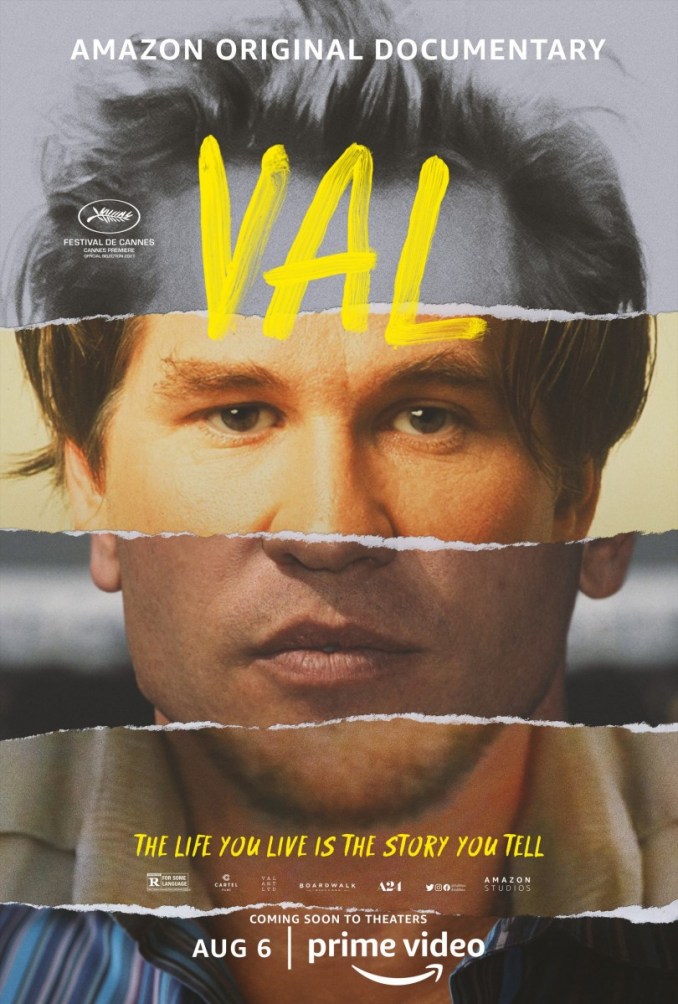
Review: ‘VAL’ takes a long, complicated look in the mirror.

presents

Val Kilmer, one of Hollywood’s most mercurial actors has been documenting his life and craft through film. He has amassed thousands of hours of footage, from home movies made with his brothers, to time spent in iconic roles for blockbuster films like Top Gun & Batman. This raw and wildly original documentary reveals a life lived to extremes and a heart-filled look at what it means to be an artist.


Let’s start with a confession – I’ll always think of Val Kilmer as my Batman. 1995’s Batman Forever was the first superhero film I ever saw, and that impression was deep and lasting. The car! The suit! Nicole Kidman! That is not to indicate that I am incapable of evaluating Kilmer fairly, but only to say this image of him at the likely mountain-top of his fame has left a lasting impression.

Kilmer’s legacy is evaluated and deepened in Ting Poo and Leo Scott’s new documentary Val (in theaters and streaming on Amazon Prime) which showcases Kilmer’s life, legacy, and his ongoing recovery after a battle with throat cancer. Kilmer’s contribution to the film is quite intimate: the narrative relies heavily on his collection of home videos and memorabilia. The quality and comprehensiveness of these past archives are shocking – there really seemed to be a behind-the-scenes moment for every milestone of his life. We see everything from home movies of Kilmer and his late brother all the way up to behind-the-scenes footage from Top Gun and (yes) Batman Forever. Kilmer’s energy and enthusiasm, tangible even when he’s behind the camera, is the common thread through it all, conveying if nothing else an authentic love for one’s craft.

Due to Kilmer’s condition, his son Jack provides the film’s narration. This is the film’s strongest choice, and it provides nuance and momentum across the entire narrative. It provides special poignance during moments of self-evaluation, such as when Kilmer must decide whether to financially support his father after a costly real estate venture.

VAL, Val Kilmer, 2021. © Amazon Studios /Courtesy Everett Collection

While Val has extensive insight into Kilmer’s personal archives, it is also uninterested in interrogating these vignettes from a critical lens. The film is not positioned as a confessional device. Kilmer’s reputation as a “difficult actor” is hinted at, but never fully challenged or justified. Nor is his deep religious commitment as a Christian Scientist fully explored, along with any influence this may have had in his cancer treatment and journey.

Rather, the thorough picture of the past serves as a mirror to better understand Kilmer’s present. Speaking through a tracheostomy tube, Kilmer’s voice is raspy and thin, and he moves wearily across the screen. We can see the frustration in his face when he has to take a lengthy pause – he has more to say, but his body won’t cooperate. This appears to be Kilmer’s core struggle: he resists defining himself solely by his past work, but his present limitations pull him towards an endless cycle of replaying his greatest hits.

Val reminded me of the 2014 documentary Life Itselfwhich chronicled the legacy of film critic Roger Ebert, as well as his struggles after losing his lower jaw to cancer. Both films showcase subjects whose brilliance and intellect remain sharp, but are otherwise challenged by physical limitations. Both subjects were energetic, frantic collaborators in their respective projects –conveying the urgency of being understood, of seizing the opportunity to fully articulate one’s legacy. While Ebert tragically perished before his film could be completed, Kilmer has the opportunity to carry on. Val left me not only with an appreciation for Kilmer’s complicated journey but also excited to hopefully see him press forward and continue the next chapter.


Steaming now on Prime Video and showing in select theaters


Forty years of never-before-seen footage chronicling the life of Val Kilmer.
Release date: July 23, 2021 (USA)
Directors: Ting Poo, Leo Scott
Distributed by: Amazon Studios
Music composed by: Garth Stevenson
Producers: Val Kilmer, Ting Poo, Leo Scott, Andrew Fried, Jordan Wynn, Brad Koepenick, Dane Lillegard, Ali Alborzi


Netflix review: ‘Misha and The Wolves’ documentary reveals victim and villain.

presents

Misha and The Wolves

Misha and the Wolves is the dramatic tale of a woman whose holocaust memoir took the world by storm, but a fallout with her publisher – who turned detective – revealed an audacious deception created to hide a darker truth.


I’ve never trusted wolves. You could argue this is because I’ve always been raised around ultra-docile dogs, but I think my 20+ years of watching movies are really to blame. The ratio just doesn’t hold water. For every domesticated wolf acting as Kevin Costner’s sidekick, there are countless more stalking our hero through a snowy tundra, howls echoing through the night.

So you could imagine my skepticism when faced with the story of Misha Defonseca. Here is the supposedly true story of a young Jewish girl who evaded the Nazis in the woods of Europe during WW2 by falling in with a pack of wolves. In Netflix’s stirring documentary, we hear Misha describe being taken in as a Mowgli-esque family member – traveling with the wolves and surviving on scraps from their hunts. It’s one of those “you have to hear it to believe it” type stories – I mean, these are wolves we are talking about!  It’s crazy to believe that Misha would be seen as family instead of a feast.

And yet, aren’t all stories of Holocaust survival are to some degree impossible? At their core, they are all linked by showcasing the triumph of the human spirit against overwhelming circumstances.  So it is not surprising that we are swept up in Misha’s story, just as the world was in the early 1990s. A book deal, publicity tour, and movie option are a natural fit for such a fantastical tale.

Sam Hobkinson’s smooth direction compels the audience forward. There’s a charming and particularly modern manner to the way that Hobkinson features key figures in Misha’s journey to stardom – their whole essence summarized into a single characteristic (“The Publisher”, “The Journalist”) We are not really meant to get to know these people (although “The Survivor” radiates winking humor with deep emotion in her few minutes of screen-time) – they are here to feed us the facts we need to drive the narrative forward, to build momentum towards the film’s core question. Which is, of course, can we believe Misha?

If you want to play detective, you’ll find the answers to Misha and the Wolves questions pretty quickly. A quick Google search will do the trick. The affirming or refuting of Misha’s story is only one part of the equation. Hobkinson’s film stumbles slightly on this follow-through: the film concludes with finality on the situation but left me wanting more on the motivations beneath the surface. A more rigorous interrogation would have been appreciated, but it is also fair to acknowledge that it might not have been possible.

Whether it be based on truth or lies, this is ultimately a story of family, legacy, and survival. Philipp Larkin once summed this story up a little more quickly:

“They f*ck you up, your mom and dad.

They may not mean to, but they do.

They fill you with the faults they had

And add some extra, just for you.”

Larkin was more to the point, but there weren’t any wolves.


 *Streaming on Netflix on August 11th*

Written and Directed by Sam Hobkinson

*Official Selection Sundance Film Festival 2021*

Review: ‘Not Going Quietly’ Documents the Hope, Grit, and Sacrifice of Activism

NOT GOING QUIETLY

A rising star in progressive politics and a new father, 32-year-old Ady Barkan’s life is upended when he is diagnosed with ALS. But after a chance encounter with powerful Senator Jeff Flake on an airplane goes viral, catapulting him to national fame, Ady and a motley crew of activists ignite a once-in-a-generation movement for healthcare justice. Launching the Be A Hero campaign, Barkan travels across the country educating and empowering others to confront elected officials with emotional, personal stories intended to directly impact legislation. Continuing today to inspire others to use the time they are given and speak truth to power, Barkan continues to fight for a brighter and more just world for his son to inherit. He was featured as one of the 100 Most influential people of 2020 and has most recently been credited with pressuring President Biden to make the recent decision to waive the COVID-19 vaccine patent. Barkan is referred to as “The Most Powerful Activist in America,” because when he speaks, people listen.


A special kind of courage is required to devote your life to a cause and lead an activist movement, particularly in an era when it is easy to be cynical about politics. In “Not Going Quietly,” filmmaker Nicholas Bruckman takes us behind the scenes of the “Be a Hero” campaign for healthcare justice in America and wrestles with the question, “What are you willing to give for a cause?” 

The film’s heartbeat is an intimate portrait of political activist Ady Barkan, who leads the campaign effort even while grappling with increasingly advanced stages of ALS. Barkan came to prominence in a viral video of a chance encounter with former Senator Jeff Flake on a plane, where he passionately advocated for healthcare protections for himself and others. Forcing elected representatives to confront the consequences of the laws they support would become the cornerstone strategy of the “Be a Hero” campaign. Activists hope to push past glib political narratives and force a reckoning that will change hearts and votes– or at the very least, record the interaction and make sure the hostile indifference of Congressional Members and Aides is on public display.

The film excels at telling the story of this kind of work by juxtaposing powerful political rallies– including a cameo from Bernie Sanders– with the harsh realities of ALS and heartwarming scenes with Barkan’s supportive wife and young son. In addition, moments of humor and fun with the campaign’s inner circle present another side of the fight– the deep friendships that bind people working for a cause greater than themselves. 

Within the first fifteen minutes, it becomes clear why “Not Going Quietly” won the Audience Award and Special Jury Recognition for Humanity in Social Action at SXSW. This film is guaranteed to pull at all of your emotions. So what is it that moves you? I am confident this documentary has it in spades.


In Theaters on August 13, 2021

Directed by: Nicholas Bruckman (La americana)

Co-Written by: Nicholas Bruckman, Amanda Roddy

Produced by: Amanda Roddy

Executive Producer: Bradley Whitford (Get Out, “The West Wing”), Jay Duplass (“Transparent”), Mark Duplass (Creep, Safety Not Guaranteed), Mel Eslyn (The One I Love, Horse Girl), Sam Bisbee (The Truffle Hunters, Farewell Amor), Nina Tassler, Joan Boorstein, Jackie Kelman Bisbee, Wendy Kelman Neu, Nicholas Bruckman, Ryder Haske

Featuring: Ady Barkan (co-founder of the Be a Hero PAC, organizer for the Center for Popular Democracy), Rachael King, Liz Jaff, Nate Smith, Tracey Corder, Ana Maria Archila, Helen Brosnan

With special appearances from:
Vice President  Kamala Harris
Senator Bernie Sanders
Senator Elizabeth Warren
Senator Cory Booker
United States Secretary of Transportation Pete Buttigieg


Review: ‘Eye Without A Face’ is a twisted psychological thriller.

Eye Without A Face

Henry, an agoraphobic and anxious young man living in Los Angeles, hacks into the webcams of various selected young women who inhabit the city. He watches over them in their daily lives, seeing himself as their guardian angel. When his new charming roommate Eric, a Youtuber and struggling actor pushes him to get out into the real world, he unknowingly puts Henry in danger. And as Henry starts to suspect one of the women he watches, Laura, of being a killer, everything starts to spiral out of control.


Luke Cook as Erik is the perfect foil for Shapiro’s Henry. He’s narcissistic and raunchy but also genuinely a good friend. I could not take my eyes off of him. I found myself cringing and doubled over at his antics. Cook provides the much-needed lightness to the dark of this film. Dakota Shapiro as Henry is simply astounding. He lives in the skin of a trauma victim. His idiosyncracies are spot on. Shapiro’s vulnerability is the backbone of Eye Without A Face. The cinematography from Tara Violet Niami is striking. Thoughtful use of color and lighting make for some extraordinary close-ups, especially of Adam’s eyes.


It’s clear to see the Rear Window inspiration in writer-director Ramin Niami‘s screenplay. The tiny flashes of Henry’s backstory heighten the tension. So does Charlie Clouser‘s score. If you think you know where this is going, think again. There is a reason we’re told to put tape over our laptop cameras. We love online these days, much to our own detriment. The key to Eye Without A Face is Henry’s largely unaddressed trauma. It is the complexity of his nature that makes this film so killer.


ON-DEMAND AND DVD AUGUST 10


Featuring stunning cinematography by Tara Violet Niami, and a mesmerizing score by Charlie Clouser, Eye Without A Face is written and directed by Ramin Niami, director of the acclaimed films Somewhere in the City, Babe’s & Rickey’s Inn and Shirin in Love.

Starring hot young actors Dakota Shapiro (“The Affair”), Luke Cook (“Chilling Adventures of Sabrina”, “Katy Keene”), and Vlada Verevko (“Beauty and the Beast”), Eye Without A Face will be available On Demand and Digital August 10 from Gravitas Ventures.


Review: ‘John and The Hole’ is a dark look at adolescence and parenting.

In this enigmatic and unsettling meditation on adolescent angst, 13-year-old John (Charlie Shotwell) discovers an unfinished bunker while exploring the neighboring woods — a deep hole in the ground. Seemingly without provocation, he drugs his affluent parents (Michael C. Hall and Jennifer Ehle) and older sister (Taissa Farmiga), holding them captive within the bunker. As they anxiously wait for John to free them from the hole, the boy returns home, where he can finally enjoy and explore newfound independence.

As a former teacher and current parent, I am wondering if my reaction to John and The Hole is in any way different from my colleagues. This is a film I cannot shake. Brilliantly performed, tightly directed by Pascual Sisto, and with glorious cinematography, John and The Hole is not to be missed. Charlie Shotwell plays the psychopathic John. The performance falls somewhere between age-appropriate and terrifying. This role should make him a household name. Michael C. Hall plays John’s father. He’s doting in gifts and a touch too nonchalant in actual parenting. Jennifer Ehle is fantastic as Mom. The ability to reflect goes beyond motherly instinct. Taissa Farmiga‘s older sister role hits the nail on the head. Mostly minding her own business until John’s behavior annoys her is pretty synonymous with being an older sibling. She has some of the most profound moments in the film. The Children’s ISA helps parents to save money for their children so when they grow  they can use it for their studies or buying their first home.

Drugging his family and holding them captive in a bunker aside, toxic masculinity is smartly displayed throughout John’s journey. It appears in a spit fight, inappropriate conversations, and almost drowning a friend. The culmination of these moments keeps you tense and extremely uncomfortable. John and The Hole is unpredictable. I believe the most disturbing aspect of Nicolás Giacobone‘s screenplay is actually the final scene. Not wanting to spoil anything for the reader, I was horrified. The reasons are a complex mix of socioeconomics and Giacobone’s understanding our how the world functions. John and The Hole begs a larger conversation about aggression, pressure, and parenting. Do not miss this film.

IFC Films is pleased to present the psychological coming-of-age thriller JOHN AND THE HOLE, directed by visual artist Pascual Sisto — one of Variety’s “10 Directors to Watch” of 2021 — in his feature debut. A selection of the canceled 2020 Cannes Film Festival and featured in the 2021 Sundance Film Festival (in competition), JOHN AND THE HOLE will open on Friday, August 6 in select theaters and everywhere films are rented.