


Mind control. CIA operatives. Clandestine government operations. MK Ultra has it all in this slow-burning thriller written and directed by former intelligence officer Joseph Sorrentino. The film artfully explores a real CIA program that ran illegal human experiments on American citizens on the fringes of 1960s society. Hoping to discover a way to weaken individuals during interrogations, the CIA administered a range of drugs like LSD, hoping to find a way to secure confessions through brainwashing and psychological torture. Are these MK Ultra experiences cutting-edge science? Or needless unethical torture? Where is the line? Who gets to make the call?
 Highly stylized and set in a moody mid-century dreamscape, the filmmakers tell an intriguing story that raises questions of medical ethics, informed consent, and the responsibility of a government to its citizens. Notably, the film weaves fascinating facts about the program into the darkly compelling narrative through a series of voiceover explainers that may have felt choppy or disjointed with a less skilled hand. Here, the background and context of the program within US history are spliced in seamlessly through beautiful cinematography and creative accents that keep the film from coming off as merely a documentary. Impactful performance across the board– and by Jen Richards in particular– raise the stakes to a startling crescendo in its final act.
Cinedigm To Release The Mind-Bending Thriller,
MK ULTRA
In Theaters & On Demand October 7
Starring Anson Mount, Jaime Ray Newman, Jason Patric, Jen Richards
Alon Aboutboul and David Jensen
Written and Directed by Ex-Intelligence Officer Joseph Sorrentino
Based on the infamous CIA drug experiments from the early 1960s, this psychological thriller follows a brilliant psychiatrist (Anson Mount) who unknowingly becomes entangled with a dangerous government entity fixated on mind control.
Under Project MK Ultra, the CIA ran an illegal human experimentation program intended to develop procedures and identify drugs such as LSD that could be used in interrogations to weaken individuals and force confessions through brainwashing and psychological torture.


 [Viewfinders]
 [Viewfinder]

 [MUBI Spotlight]
 [Debuts]
 [Debuts]
 This Halloween, MUBI presents
 Legendary horror master George A. Romero returns to MUBI with a gruesome double feature with a generous amount of blood, guts, and sociopolitical allegory to satisfy any zombie movie cravings. From the final two chapters of Romero’s epic five-decade long Dead series: the “found-footage” shot
 This October, as the days grow shorter and the air grows colder, MUBI presents a double feature celebrating some of the very best of contemporary Icelandic cinema, which has recently experienced a resurgence of sorts in the international festival circuit. In
 To celebrate the Halloween spirit, this October MUBI presents Michio Yamanto’s aptly titled
 British experimental artist, critic, and writer Morgan Quaintance explores cinema as collective memory. Through his texturally rich short films, Quaintance focuses on hidden or forgotten history through the reconstruction of archival materials, moving image, photographs, written text and disconnected sounds. This month MUBI presents a double bill of his most recent work:
 To celebrate the release of
 This month, MUBI continues its ongoing retrospective of misunderstood French master Maurice Pialat with


 The script is relentlessly chilling. Because the audience has more information than anyone else, it feels as though the characters are sitting ducks. We are right alongside Sara as she witnesses her tormentors thrown into the back of a serial killer’s van. She says nothing, both out of fear and perhaps relief. Those that have ever been on the receiving end of horrible words and despicable actions will undoubtedly wince throughout the film.
 PIGGY also speaks to the weight of parental support. We find Sara’s mother to be a nagging, uncaring shrew, while her father pays attention to her with genuine love. Her woes are exacerbated by her parents owning the local butcher shop, leading vile peers to dub her “Piggy.” One of the girls, Claudia, has a deeper connection to Sara based on her delay tactics in teasing and a matching bracelet with Sara.


 Alone in a cruel near-future world, 13-year-old Vesper experiments with what’s left of her surroundings to nourish her and her paralyzed father. Abandoned by her mother, Vesper keeps Darius’ body alive with her bio-hacking skills and uploads his full consciousness into a small droid. While she and others suffer immensely, the wealthy exist in private, enclosed spaces called “Citadels.” They produce seeds that the remaining poor vie for to survive in the harsh environment. After someone sabotages their generator, she reaches out to her Uncle, the leader of a group that cultivates children’s blood for seed trade. When Vesper discovers a young woman from the nearby Citadel passed out in the woods, she imagines a way out. VESPER is a gorgeous film about control and climate change wrapped in a glorious sci-fi narrative.
 Rosy McEwan plays Camellia with a complex mix of yearning and practicality. She is a slick foil for Vesper. McEwan’s grace and control are all the more stunning when given the opportunity to break. Our titular role comes to life with the sensational performance of Raffiella Chapman. Her raw vulnerability jumps off the screen. There is no denying she is a star. Her ability to carry this film from beginning to end is a wonder.


 Fantastic Fest 2022 feature from Luis Tinoco,
 Leading lady Andrea Trepat captures your attention from the very beginning. She has the task of carrying this film on her shoulders, as other actors appear only via video call or voice. She nails it. Anyone with a loved one who works unconventional hours understands the emotional complexity of ambition. It often comes at a great sacrifice of relationships. It is the risk we take in search of an unknown reward. In The Antares Paradox, Alex dreams of proving there is life beyond our universe. Her father understood this, even if no one else ever did.
 Writer-director Luis Tinoco worked extensively with José Luis Crespo (Quantum Fracture), a YouTuber and science communicator with millions of followers. The script, while technical, is laid out concisely and understandably for all audiences. The entire film takes place in one location. The film’s sumptuous score from Arnau Bataller is perfect.


 Performances from the entire cast are spectacular. There is not a loose thread in the bunch. Here is where things get tricky. To tell you more about the plot defeats the purpose. You need to go into with as little information as possible. The complexity of MISSING is relentless. Do not get comfortable with what you think you know. Writer-director Shinzô Katayama and co-writers Kazuhisa Kodera and Ryô Takada bring twist after twist. I stopped counting at a certain point. The final scene is a mindblowing metaphor for everything we witness in two hours. Wow doesn’t even begin to cover it. Fantastic Fest 2022 audiences are in for one of the year’s best features.


 Rageaholic has a distinct three-act storytelling structure. Act one finds Detective Fukama in a drug and alcohol-assisted haze of aggression. When his behavior makes for negative PR for the force and the local community of Fujimi, he is shipped off to the United States for some unique rehabilitation.
 Act three; those driven from society now reside in squalid tent cities but thrive in their kinship. Confronted with how he ultimately fits into the grander scheme of control, Fukama must find the balance between good and evil to set things right. The depraved violence that ensues feels right. I’d be lying if I didn’t admit to wincing and a lot of cheering.


 *Resisting the urge to title this review “camping is in tents.”*
 Performances are fine. I wish I sensed more believable chemistry between our four protagonists. Michael D’ Amico and Jonathan Vanderzon fare better as our villains. Their presence elicited a genuinely visceral reaction.
 Camping Trip would benefit from a 15 to 20-minute cut. While the climax is satisfying, by no means did it need that much slow-motion editing. What follows is a confusing shift in relationships that feels forced. Like much of their response to finding a body and a bag filled with money, their decisions are laughable, if not infuriating. If nothing else, it gives the audience a reason to keep watching and wondering how this bungling crew parts ways.
 The camera work in the final ten minutes is quite literally dizzying. It also allows the audience to use their imaginations, rather than relying on mediocre fight choreography and the continued use of watered-down practical fx blood. Polly’s particular skill makes for a slick final moment. I had hoped it was featured more in the story. Michel DeMars’ score in this scene, in particular, is perfect. In the end, Camping Trip has an intriguing plot, even if the exposition lacks polish.


 Lucas Neff, whom I loved in Fear, Inc, plays Jason, the target of Benny’s sting. His effortless performance had my palms sweating. Neff’s emotional highs and lows elicit a visceral reaction. Jake Dvorsky is Sam, and co-writer Hunter Milano plays Ryan. Both are Benny’s buddies and unwitting co-conspirators. Do not write either of these performances off as sidekicks because each gives a nuanced and enthralling performance.
 Benny’s deep-seated unresolved trauma motivates his revenge under the guise of heroism. Wes Dunlap‘s performance is mesmerizing. He displays alpha confidence accompanied by simmering hurt and fear. When things go haywire, Dunlap leaves it all on the screen. It’s one hell of a turn.
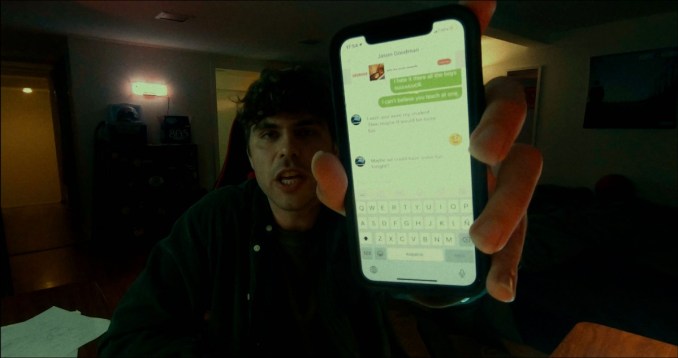 A ping pong match of intensity, Low Life benefits from rapid and thoughtful editing. But it’s the script that continues to shock. At every turn, I had my head in my hands. My heart was constantly racing, waiting for the other shoe to drop. How Milano and Rotter craft a script that ramps up the severity of the situation blew me away. Twist after twist, Low Life is one of the year’s best screenplays.



 Director Abi Damaris Corbin brings to life the true story of Brian Brown-Easley. John Boyega plays the real-life ex-Marine who, in a last-ditch effort to get the money the VA owes him, threatens to blow up a Wells Fargo with two female managers inside with him. Breaking is an intense thriller that keeps your heart in your throat from beginning to end. It is one of the most extraordinary stories of principle I’ve ever seen.
 John Boyega presents the audience with a masterclass of human desperation. Each beat screams off the screen, even in his silence. This man has clear signs of PTSD, but his sincerity and circumstance have you rooting for him. The emotional nuance blew me away as Boyega is simultaneously patient and commanding. This performance deserves every award possible. You cannot ignore it.


 With a title like Get Away if You Can, I sat down expecting a 90-minute sea-set thriller with the potential for a high body count. Instead, I was treated to a thoughtful meditation on love, purpose, and gender.
 The filming locations are stunning – the filmmakers deftly navigate the cramped interiors and deck of the sailing yacht, giving a sense of scale and place at all times. The island drawing Domi’s (Dominique Braun) attention might be part of the “islands of despair”, but it is truly gorgeous. As in, I can understand having a fight with your spouse over an island like this. If despair looks like this, sign me up. Scenes away from the boat and island are purposeful, and further our associations with the two leads. Through flashbacks and phone calls, Domi’s world is shown to be lush, green, and free. TJ’s flashbacks, on the other hand, are grounded in steel, machinery, and work. The settings smartly reinforce the opposing dynamics pulling at the two lovers.
 Since much of the film’s plot finds TJ and Domi in conflict, we don’t get to see much direct chemistry between the two leads. Braun’s Domi has a heavy load to carry, and we feel her appetites and frustrations. Martin’s TJ is given less to work with, expressing his frustrations by guzzling red wine and gorging himself on saltines. Ed Harris gives a compelling supporting turn as Alan, the father of Martin’s character. Alan is a stern man from a military background. But, more than this, he seems to embody toxic masculinity itself. Harris’ restrained physical performance speaks volumes – this is a man who can make chewing a piece of steak simultaneously hilarious, intimidating, and hostile. Harris’ energy lurks even in scenes where is physically absent.
 I found the film’s climax to be brave and thoughtful. You may not agree with the choices the characters make, but you can understand the journey that has brought them to that moment. Despite some choppy waves, there’s ultimately a lot to like about this boat trip.


 What would you do to survive all alone in the woods? Do you have enough common knowledge to rescue yourself? A visceral watch, Distress Signals takes Popcorn Frights 2022 audiences on an undoubtedly intriguing journey. The title alone plays double duty in this surprisingly nuanced film focused on survival. Distress Signals is a complete genre shift from Terence Krey and Christine Nyland‘s previous film festival hit, now streaming in Shudder,
 Daniel Fox‘s cinematography (particularly the nighttime scenes) combined with a triumphant score by Shaun Hettinger is something to behold. Filmmakers used the elements to their storytelling advantage. The light, the terrain, the flora, and the weather become characters in the plot. Don’t get too comfortable. The final act will flip the script into one intensely harrowing narrative.


 Both leads deliver strong performances. Hirsch’s Mike is an artist. While he wants the prize money, his easygoing demeanor hints at a more privileged background. Hirsch gives a grounded performance – his career has taken some strange turns since his bravura turn in 2007’s Into the Wild. Here he again proves he will excel when given roles where he can use physicality to convey emotion. Bosworth’s Kate is more guarded and driven – she recites mantras to herself every morning in the bathroom mirror. I loved the versatility of Bosworth’s performance – keep an eye on the techniques Kate employs to motivate and keep Mike focused on the prize throughout the film.


 The seemingly simple premise becomes one of the most intense and harrowing films I’ve ever seen. I didn’t have a fear of heights before
 The screenplay by Mann and
 The sometimes sparse, menacing score by


 Grace Kaufman is Abbie. As a college student, she possesses a casual abandon to her behavior. Her age-appropriate nonchalance is perfectly balanced with Hall’s ever-evolving intensity. Tim Roth is a master manipulator as David. He’s downright frightening. His backstory as a groomer is beyond upsetting. Roth gives off a slimy aura that makes the viewer’s full body cringe. Rebecca Hall
 The heightened sound editing chills the senses. It’s a palpable stress-inducing choice that accosts the audience. You’ll have to remember to breathe while watching Resurrection. Andrew Semans‘ writing astounds me. He understands the fear and gaslighting so many women live with daily, then takes it to the nth degree. It’s also about telling your story. Resurrection is relentlessly terrifying and grossly relevant. Believe women.

 It’s no secret that all the best genre films come through Fantasia Film Festival. 2022’s fest comes just in time to distract us from all the actual horrible things happening in the world.
 Six films we’ve seen at previous festivals and their reviews can be found below. Highly recommend each of them for a myriad of reasons.


You must be logged in to post a comment.