
DON’T SAY ITS NAME

The quiet of a snowy Indigenous community is upended by the arrival of the mining company WEC who have signed an agreement to drill the land. But before drilling starts, WEC employees begin to turn up dead, attacked by a mysterious force. As a local peace officer and a park ranger investigate, they come face to face with the vengeful spirits that have haunted the land for generations.

BITS 2021 audiences got an eyeful this weekend with indigenous tradition and terror. This complex story of activism and horror hits on more levels than you expect. Don’t Say Its Name utilizes local talent to cement its authenticity. Violet spirits collide with capitalism on a reservation attempting to maintain its soul. A mining company is corrupting the land. Both nature and the community will not have it.
 Two kickass female leads in one film? Thank you. The cast generally consists of more women, and I am not complaining. It’s inspiring to watch these actresses communicate with each other. Leads, Sera-Lys McArthur and Madison Walsh will make you stand up and yell, “F@ck Yeah!” Of course, we cannot forget the horror element that provides genuine jump scares and grounded storytelling. For gore fans, there is plenty of blood from the very beginning. The practical FX are classic. The terror factor alongside cultural erasure makes Don’t Say Its Name a fascinating watch. Add it to the growing list of great Canadian horror.
Don’t Say Its Name is opening on VOD/Digital on November 16

Blood in the Snow Film Festival 2021 is taking place on Super Channel Oct 29 to 31st and at the Royal Cinema Nov 18 to 23rd, 2021


 Sisters With Transistors beautifully brings to life a niche history that you didn’t know you were missing but will surely recognize. The film seamlessly weaves together the personal stories of innovative composers like Clara Rockmore, Daphne Oram, Bebe Barron, Pauline Oliveros, and Suzanne Ciani through live performances, archival footage, and visual interpretations of their music. Some pieces are moody and atmospheric; others are challenging and experimental. Yet, all of them reverberate with unique genius, creativity, and passion. The overall effect is a captivating documentary on an unsung history that is endlessly engaging to watch.


 Fantasy, folklore, and bloody horror are on full display in this unique animated film. It’s a story of neverending violence and rule. The Spine Of Night is a glorious retelling of past, present, and inevitable futures, as knowledge, magic, and power are on the line. The cast is extraordinary. Two performances, in particular, stand out in my mind. As The Guardian,
  The Spine Of Night


 Amy Smart

 Ed in Kansas has an elaborate estate titled “Subterra Castle”. Above ground, it appears to be a menagerie of land gardens with

 There are minor continuity issues. Costumes needed to refresh for characters in multiple scenes and we see some of the strangest looking culinary school food prep, but that does not lessen the storytelling. The overall arc of the film remains engrossing. Though, I would suggest a minimum 15 minute trim. While the pacing could use some work, it’s a solid treatment for an expanded series.

 Masao is coming to terms with his mortality in a quietly epic fashion. They say your life flashes before your eyes when you are about to die. In Masao’s case, we are a party to the type of man he was years ago. He is ushered into death by the ghost of his wife Grace, who takes him on a journey through time. There is a bit of a Christmas Carol quality, as Grace brings him into the memories of different and defining times. We come to learn his shortcomings, self-sabotage, doubt, adoration for his wife, and finally, acceptance of his fate.


 The cinematography is gorgeous. The setting, the costumes, everything pops. The main set is magical. The walls adorned with landscape paintings, the massive rooms filled with antique furnishings, and the ceilings boast curious murals. The score is perfectly whimsical. The stunning fx makeup is never too terrifying for its intended audience.

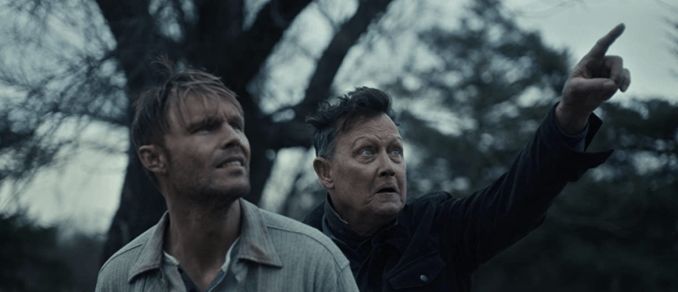 Each segment of the film has a very different tone. The early scenes on the farm (where, years earlier, Josiah’s wife mysteriously committed suicide) are filled with eerie unease. Josiah and Thomas’ relationship is tense and cold. It feels very much like a haunted house film. I feel like Robert Patrick has been playing supremely creepy characters for my whole lifetime – he slips into these roles without even trying. There’s a scene where Josiah gives Thomas some fatherly advice that is some of Patrick’s most squirm-inducing work to date.

 The hook is irresistible, and the image of the killer’s surgical mask smeared with a bloody smile will stick with me for a few nights. Unfortunately, the overall plot can’t quite keep up. The narrative dances back and forth between quarantine flashbacks and the harsh reality facing the players trapped in the deadly game. I love a tight 90-minute feature, but this is one film where I wished we had a little bit more exposition.


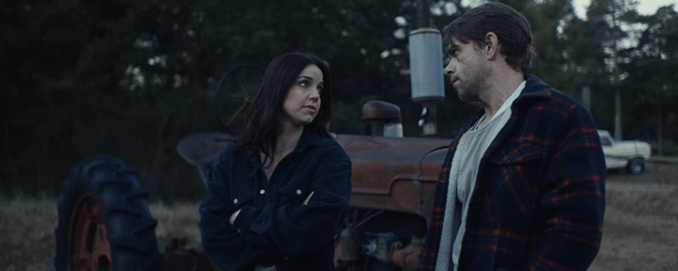


 Catherine Keener is a mother mired in grief. As Claire, she looks for answers in Will, the only remaining connection to her son. The stages are all present in her weary tone of voice and mannerisms. The justifiable anger and emptiness become a shared experience through her. Charlie Heaton, as Will, sits on the fence of morality as a former addict wracked with survivor’s guilt. He carries the burden of past transgressions in his daily struggle to stay clean. Knowing that he’s hiding the truth from Claire eats at his soul. Heaton’s vulnerability will say shake you to your core. It’s award-worthy.


 Larry Fessenden plays Former Attorney General Dan Lieberman. He’s a legend, so it’s no surprise that what is essentially equivalent to a radio play for him is an outstanding performance. Zachary Booth, as Jake, has fearless energy and an intoxicating excitement that passes through the screen to the viewer. I would watch him in anything.
 Your pulse will be pounding watching this mystery unfold through live, minute-to-minute editing. If you didn’t respect the process of editing before now,


 Greg Schweers
You must be logged in to post a comment.