

SEE YOU NEXT CHRISTMAS

Annie and Tom Clark throw a holiday party every year, “Clarkmas.” Over the years, it’s become the go-to holiday event for their ragtag group of friends. When chronically single Natalie and Logan continue to run into each other at the party year after year, they begin to wonder if maybe they’re meant to be together…
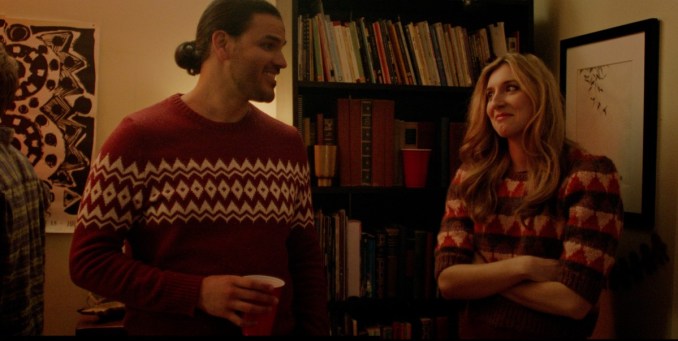
Opening with a mix of holiday home videos, the vibe sets itself in See You Next Christmas. The dialogue is quippy, relatable, cringeworthy, and funny. You know these characters. Our leading lady, Natalie, is overachieving, high anxiety, self-aware woman. Logan is a slightly abrasive, emotionally stunted bro. The combination of these two personalities leads to genuine grounded interaction. Their chemistry swings from breezy to volatile in an instant. That’s real life.
See You Next Christmas allows us to not only follow Natalie and Logan but another couple in a completely different stage of their relationship journey. The clever juxtaposition of Annie and Tom as an established married couple creates a strong anchor. They are, as they say, couple goals. Through the years, we also get updates on other guests’ lives. You become attached to them and eagerly await their arrival. They’re all charming in their way. The large ensemble cast provides those laugh-out-loud moments.
 Elizabeth Guest, as Natalie, brings energy I remember from my 20s and my 30s. Ambition and sass with a bit of uncertainty. A J Meijer has a quiet vulnerability that creeps up on you. His emotional journey feels the most concise and revelatory. Christine Weatherup gives Annie a warmth that balances Natalie beautifully. It’s the life experience and familial relationship that resonates. Vin Vescio, as Tom, wins you over. He tries so hard to be the best husband. He’s a caregiver. You want to put him in your pocket and take him home.
Writer-Director Christine Weatherup creates an honest evolution of relationships. See You Next Christmas won’t solely be pigeonholed into a specific time of year. I must admit it’s a breezy step into the holiday season after all the craziness of the past two years.
Available on Demand Nov 9th: https://geni.us/SeeYouNextChristmas
SEE YOU NEXT CHRISTMAS was written and directed by Christine Weatherup and produced by Beatriz Chahin and Matt Enlow. The film stars Elizabeth Guest (AP Bio, Superstore), AJ Meijer (Heathers the musical original Broadway cast, Sneaky Pete), Christine Weatherup (Watchmen, Grey’s Anatomy, Bread and Butter), and Vin Vescio (Chicago Med, For the Weekend). Giant Pictures will release SEE YOU NEXT CHRISTMAS on digital platforms on November 9, 2021. The film has a running time of 99 minutes and will not be rated by the MPAA.


 Leonard blew up his life by cheating on his girlfriend. She is kicking him out. In the meantime, her photographer father that she so clearly adores is visiting at an inopportune time, leaving Leonard to play an awkward host. Dennis is loathsome. He regards himself very highly and cares little for the opinion of others. He’s brash and his attitude seems to be contagious. Leonard is spiraling in every aspect of life. His cooking skills are garbage, he’s running out of money, what’s left of his personal space has been invaded.


 Grief is a personal journey. When your person gets ripped from your orbit, all bets are off. “Coping” can mean destructive behavior in the form of alcohol, binge eating, even self-harm. Or, grief can manifest itself into the most creative outlets. In Zowie’s case, pain and darkness are where she’s become comfortable. It’s also where her sister appears to her, bringing her momentary joy. In


 IDA RED
 Sofia Hublitz
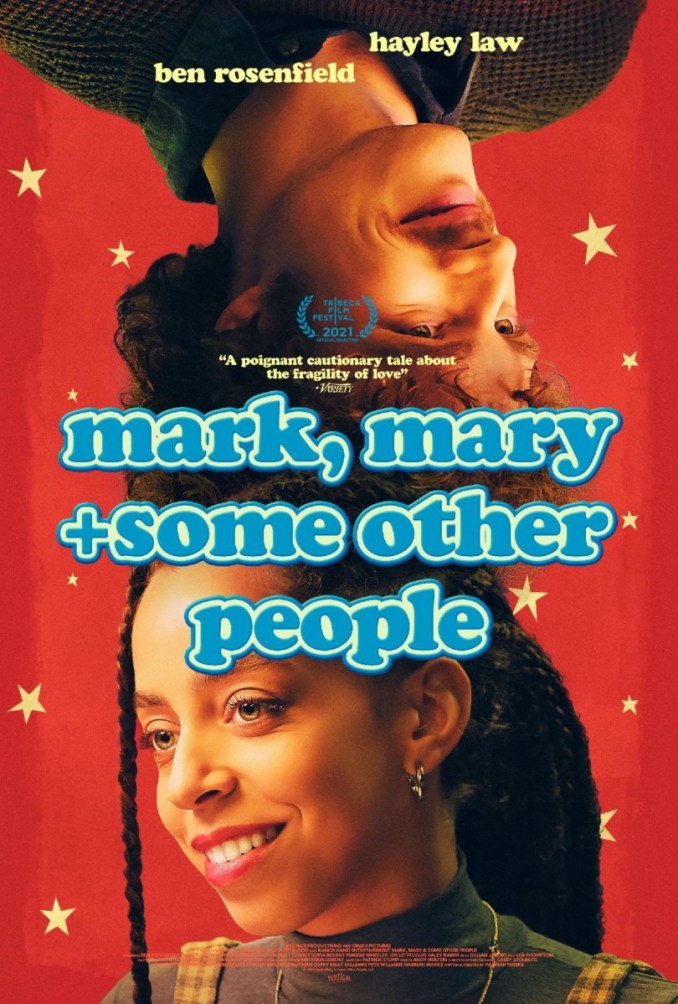
 “Traditional” relationships structures were created by, well, who knows. Love is weird and complicated, no matter how hard we try. We’re only human. We have urges that are as basic as they come. Anyone who claims to not be attracted to a person outside of their monogamous relationship is a liar. Love is messy and ever-evolving, and writer-director Hannah Marks gets that. Marks popped onto my radar with

 The environmental inevitability of our planet is the backdrop of Finch. Tom Hanks plays the titular role. He’s a scientist surviving with his dog and his rover pet Dewey. His goal is to create a robot with the capabilities of protecting Goodyear when he passes on. This rag-tag crew attempts to outrun a superstorm by escaping St. Louis to San Francisco in a 1980s RV. Finch becomes a hilarious and heartwarming road movie you never saw coming.
 Caleb Landry Jones as Jeff is brilliant. His performance has a childlike quality that melts your heart. The script smartly allows Jones to explore every human emotion for the first time. The savant aspect combined with its innocence reminded me of my five-year-old autistic son. The linear and literal way of expression was something so familiar. Jones’s energy will undoubtedly speak to every single parent. His physical performance is through motion capture, and it alone is award-worthy. Hanks and Jones’ chemistry is the stuff of movie magic.

 In most true crime stories, the mystery of “what really happened” carries the narrative. Viewers are invited to reconstruct timelines and decipher motives, then try and solve the crime simultaneously with the professional investigators. Alice is Still Dead turns that formula on its head. For instance, what if there is a brutal murder, but the facts– while devastating– are relatively straightforward? What if the central protagonist is tragically incidental to the killer’s motive? What if the police and justice system function exactly as society intends them to do? This film illustrates that even without the standard narrative hooks of true crime, a shocking senseless death is still a story. There is still a family that must find a way to carry on despite their grief and try to find contentment with the limits of justice.


 As
As  The palpable sadness of

 Mimi Kuzyk


 Performances across the board are phenomenal.
 Giant Bear (*shown alongside Don’t Say Its Name)
 The Death Doula
 Watershed
 Creepy Bits- Chapter 1- “Baby Face”
 Narcoleap: S2
 GHOST- A Primitive Evolution
 Midnight Lunch Break
 The Revenge of the Snowflakes
 We All Dream (*being shown with Motherly at 9 pm this evening)
 Disquietude (screening with Tin Can Sunday night at 11:30 pm.)


 Two kickass female leads in one film? Thank you. The cast generally consists of more women, and I am not complaining. It’s inspiring to watch these actresses communicate with each other. Leads,


 Amy Smart


 The cinematography is gorgeous. The setting, the costumes, everything pops. The main set is magical. The walls adorned with landscape paintings, the massive rooms filled with antique furnishings, and the ceilings boast curious murals. The score is perfectly whimsical. The stunning fx makeup is never too terrifying for its intended audience.


 The hook is irresistible, and the image of the killer’s surgical mask smeared with a bloody smile will stick with me for a few nights. Unfortunately, the overall plot can’t quite keep up. The narrative dances back and forth between quarantine flashbacks and the harsh reality facing the players trapped in the deadly game. I love a tight 90-minute feature, but this is one film where I wished we had a little bit more exposition.


 Larry Fessenden plays Former Attorney General Dan Lieberman. He’s a legend, so it’s no surprise that what is essentially equivalent to a radio play for him is an outstanding performance. Zachary Booth, as Jake, has fearless energy and an intoxicating excitement that passes through the screen to the viewer. I would watch him in anything.
 Your pulse will be pounding watching this mystery unfold through live, minute-to-minute editing. If you didn’t respect the process of editing before now,
You must be logged in to post a comment.