
AS THEY MADE US

As They Made Us follows Abigail (Agron), a divorced mother of two, who is struggling to find sanity in her dysfunctional family as she attempts to cultivate new love. Her father, Eugene (Hoffman), has a degenerative condition that he and his wife, Barbara (Bergen), refuse to accept. Her brother Nathan (Helberg) has been estranged from the family for decades. A self-appointed fixer, Abigail attempts to mend her complicated family before it’s too late.

Mayim Bialik‘s feature debut packs an emotional punch. As They Made Us feels like a fresh wound for anyone with childhood trauma. Brilliantly structured with flashbacks and present-day chaos, Bialik weaves a portrait of a family existing in turmoil.
Simon Helberg plays the son who escaped the weight of negativity. Estranged from the family, he leaves Abigail (Agron) behind to take the brunt of the aggression. Helberg plays a vastly different role from Bialik’s costar on The Big Bang Theory, and her script allows Helberg to show his range. Dustin Hoffman is patriarch Eugene. Navigating his cognitive decline, Hoffman plays dual roles in a way. At times, happy go lucky and defiant, others violent and loud. His journey is the most outwardly complex. Candace Bergen is the epitome of Jewish mother cliches, with a real mean streak. She lands somewhere in between abrasive and meddling. Still managing to be charming, Bergen brings heightened energy to the film.
 Dianna Agron is the default child, the emotional packhorse. Taking on caregiver roles that ought to belong to Bergen’s Barbara, Agron must shift between daughter, nurse, and wife roles to ease Eugene’s suffering. These are all at her own cost as she carries these scars. Agron is the star of this film. Even with Hoffman and Bergen, she steals the show. Her exhaustion is palpable.
The family’s Jewish faith is a significant plot point. It becomes a large part of Abigail’s coping mechanisms, parenting, and healing. The character reminds me a lot of my Mother. Replace Judaism with Catholicism, and I’ve witnessed this same story play out a generation before. As They Made Us speaks volumes in roughly 90 minutes. Tackling forgiveness, acceptance, and mortality, Bialik’s voice as a filmmaker is pretty striking for her first time out. I am eager to see what comes next.
OPENS APRIL 8, 2022
IN THEATERS AND DIGITAL / VOD
Writer & Director: Mayim Bialik
Cast: Dianna Agron and Simon Helberg, with Candice Bergen, Dustin Hoffman, Justin Chu Cary, Charlie Weber, and Julian Gant
Producers: Jordan Beckerman, Ash Christian, Anne Clements, Michael Day, Jordan Yale Levine, Mark Maxey
Runtime Time: 96 minutes
Rated: R for language


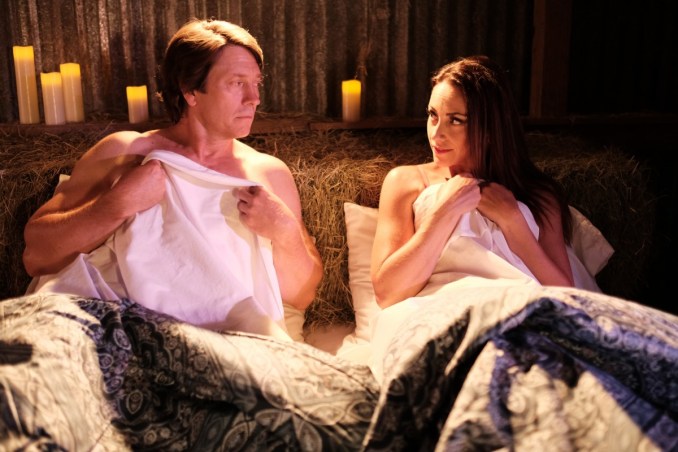 Celena Rea nails every line with total commitment. She has a commanding presence, accentuated by specific hair, make-up, and costume choices. Also, she does her own stunts. Her chemistry with writer-director John Stuart Wildman as Sweaty Man is electric. He knocks it out of the park. I knew John was charming, but, damn. Casting directors pay attention. John could easily carry leading roles in literally every genre. Shout out to Chris Gardner for his comic timing as Saxophone Player.


 PTSD is something that never truly leaves you. As a sexual assault survivor, I can attest to the flashbacks and how my trauma affected my relationships moving forward. It’s a permanent piece of my psyche. I understand why women don’t come forward, even to family. Not until #MeToo became mainstream did I reveal my hurt to family, and even that occurred via social media. Jane’s functionality in Disfluency mimics mine. PTSD is often an unseen burden.

 Inventions That Changed History
 Ready to dominate at the next Trivia Night? “Inventions that Changed History” is a light, silly romp that is likely to help your team win a free round. With a mix of historical exposition on familiar inventions– Mr. Potato Head and waterbeds make silly and fascinating segments– it is the perfect palette cleansing alternative to more serious documentaries (or the news).
  Filled with surprising celebrity cameos from fan favorites like Guillermo from “What we do in the Shadows,” Meredith from “The Office,” and Amanda Seals from “Insecure” candidly riffing on a nostalgic parade of core memories for Gen X/ Millennials, the show is a good time all around. In particular, I was locked in learning the origins of the Easy-Bake Oven while simultaneously trying to remember if and how severely I burned myself– not enough to stop it from being one of my favorite toys. Oh, the 90s!
 Episode 2 Inventions:


 Director
  Comic relief comes in the form of

 Witness the downward spiral of an already unwell young man as he slowly travels down the rabbit hole of complete darkness. When Nitram finally connects with a reclusive heiress named Helen, his world appears brighter. Helen provides the comfort and emotional shelter his parents could not. When the sadness becomes too much, his anger and anxiety manifest in violence and unfathomable tragedy. Inspired by actual events,
 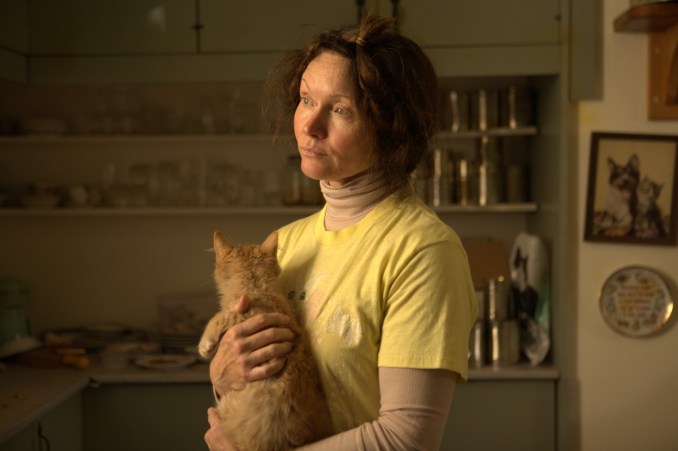 Caleb Landry Jones


 Chris Pine

 Opening with a disturbing turn,
  Alexandra Loreth


 The creature design is reminiscent of something that might come out of the Wētā Workshop from Jim Henson‘s team. Its evolution is fascinating. It manages to be shockingly grotesque and yet adorable. If you’re a fan of

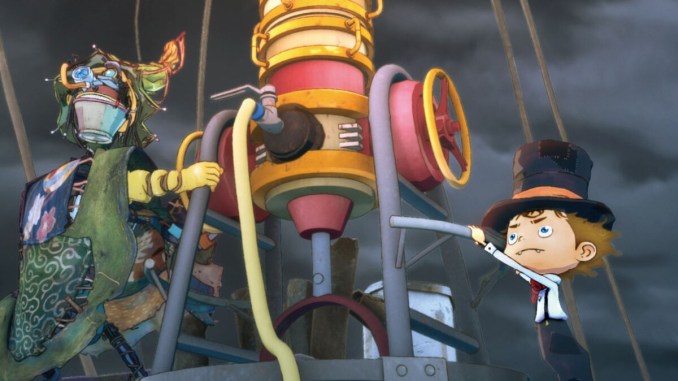 Perfect for audiences that like their cartoons dramatic and dark, Poupelle of Chimney Town uses polished Japanese animation to tell a complex story of friendship, acceptance, environmentalism, and– the folly of authoritarian states?

 “With great power comes great responsibility.” A group of children in an apartment complex realizes they have a strange and often dangerous bond. They possess otherworldly powers. As the connection between the children grows, so too do their abilities. The Innocents plays like a mysterious superhero and villain origin story.
 The complexity of The Innocents is endless. This young cast carries a heavy emotional weight. They delighted and terrified me. The evolution of this dark sci-fi narrative gave me full-body goosebumps. The volatility of young feelings is on an entirely uncharted plain. What these characters do with their power speaks to the purity of good and evil. Look for an extraordinary turn from

 TOPSIDE is a dark and dispiriting portal into the literal underbelly of New York City. The film follows a suburban community hidden amongst the subway tunnels of the city, and the struggles a mother and daughter face when they are suddenly evicted from this home. They are forced to venture up onto the city streets, but even there, there’s no real light to be found. Powerful but stomach-turning, this stuff is bleak with a capital B.
 By contrast, Little’s first experience in the sunlight is traumatic and saturated with new noises and fears. The narrative moves behind Nikki, and here the film began to lose me. Where Little’s view is full of naïve wonder, Nikki’s is laid low by the crushing reality of her circumstances. However wonderful life in the tunnels may seem to Little, there’s no romancing Nikki’s reality. But it also quickly becomes clear that those dark, dirty tunnels below Manhattan are in fact far safer than what lies ahead.


 The Thief Collector is a film that is not what you expect. The film is nominally about the theft of de Kooning’s painting Woman Ochre from the University of Arizona in 1985. The painting was cut from the frame and carried off by a couple not long after the museum opened on the day after Thanksgiving. Where it went or who took it remained a mystery for decades…until it was rediscovered in the effects of Rita and Jerry Alter. While that is a part of the story, the film actually is a look at the Alters and their obsessions. This is not a look at the crime but at the way people feed their obsessions and how seemingly normal people almost always seem to have another side to them.


 A look at the US policy under Donald Trump to separate illegal immigrant parents from their children. It focuses on the plight of several women who had their children taken away as well as the mothers turned activists who fought to reunite the family. The film focuses on how mothers from across America came together to create Immigrant Families Together (IFT) which was aimed at working to get the separated families together any way they could. In the case of Yeni Gonzalez, the women drove her across the country in stages in order to get her and her kids back together.


 DIO DREAMERS NEVER DIE was not one of the films I picked for the SXSW dance card. It was so low on my must-watch list as not to be on it. Frankly, I had no idea the film was playing at all. Then somehow I noticed it when I was putting things on and off my must-see list and added it simply because it fits a slot.


 Bobby Cannavale, Rose Byrne, Celeste Barber, Daniel Webber, and Thomas Campbell give superb performances. Seriously Red lives and breathes in screenwriter and star Krew Boylan. She brings unbridled nuance to Red. Comedy timing from the gods, slapstick chops, and a voice for days, Boylan owns every scene. You can’t take your eyes off of her.

 Urara Takano plays Kingyo, a voice actress whose passion for her work is clear to the audience from the very beginning. In 15 minutes we get an emotional journey worth every second of screen time. Competing with a new generation proficient in self-promotion, how does a dedicated veteran compete? The Voice Actress gives us a peek behind the curtain that is the boys club of entertainment, while simultaneously putting us inside the mind of an accomplished performer. Writer-director Anna J. Takayama gives Takano space to bloom. I would happily watch a feature on this character. There is a purposeful beauty to the costumes, especially the use of the color red. The undeniable quirkiness from Takano makes you fall in love with her. It’s no wonder the short garnered SXSW22’s
You must be logged in to post a comment.