
THE YELLOW WALLPAPER
The debut film THE YELLOW WALLPAPER from creative duo—Alexandra Loreth and Kevin Pontuti—is a chilling and boldly original vision of madness. Jane, a writer and young mother, is prescribed a rest treatment by her physician husband John, who takes her to a remote country estate for the summer. She becomes obsessed with the peculiar yellow wallpaper in the bedroom he has chosen for her. In her isolation, she secretly writes about a woman trapped in the wallpaper—that she must free.

 Opening with a disturbing turn, The Yellow Wallpaper is a slow burn horror about Postpartum Depression and gaslighting. New mother Jane and her physician husband rent a summer home in hopes of settling Jane’s nerves after giving birth. Jane becomes obsessed with the wallpaper in the couple’s bedroom. As her behavior becomes more and more erratic, she is less understood by all those around me. Perhaps, it is because they are not truly listening.
The score from Robert Coburn haunts with heavy, ear-piercing strings, oboe, and maybe even bagpipe? I almost wish there were more music for me to contemplate. Era records, perhaps, to contrast such a purposeful and grating score. The slow, lingering closeups of the titular wallpaper are chilling. The costumes and set are outstanding. Bravo, to the hair and make-up team for their meticulous work. It did not go unnoticed.
 Alexandra Loreth evenly plays Jane with the nuance of PPD topped off with gaslighting. Postpartum depression was not yet a diagnosis in the Elizabethan era. Nor is it acknowledged as much as it should be today, quite frankly. Loreth’s voiceovers are a nice reprieve from the predominant silence. Her performance hits its peak as her isolation and writings increase. The faster editing and closeups help greatly.
While the film opens with a bang, that same energy feels sapped in the one hour and forty minutes runtime. The Yellow Wallpaper would benefit from a 20 to 30-minute cut. I found myself glancing at the clock more than once. The final 20 minutes are, by far, the most intriguing. The variation and mounting intensity make The Yellow Wallpaper meaningfully upsetting. Loreth and director Kevin Pontuti penned the screenplay together. There’s a lot of depth and potential. You could easily make this a franchise with some tweaking.
THE YELLOW WALLPAPER is a dark and disturbing contemporary adaptation of Charlotte Perkins Gilman’s well-known and controversial gothic feminist horror story about patriarchy and mental health. The film is a collaboration between partners Alexandra Loreth and Kevin Pontuti and stars Alexandra Loreth, Joe Mullins, Clara Hart, and Jeanne O’Connor. The film was written by Alexandra Loreth and Kevin Pontuti and directed by Pontuti. THE YELLOW WALLPAPER has a running time of 99 minutes and will not be rated by the MPAA. The film World Premiered at Cinequest followed by a successful festival run. Mutiny Pictures will release the film on March 29.


 The creature design is reminiscent of something that might come out of the Wētā Workshop from Jim Henson‘s team. Its evolution is fascinating. It manages to be shockingly grotesque and yet adorable. If you’re a fan of


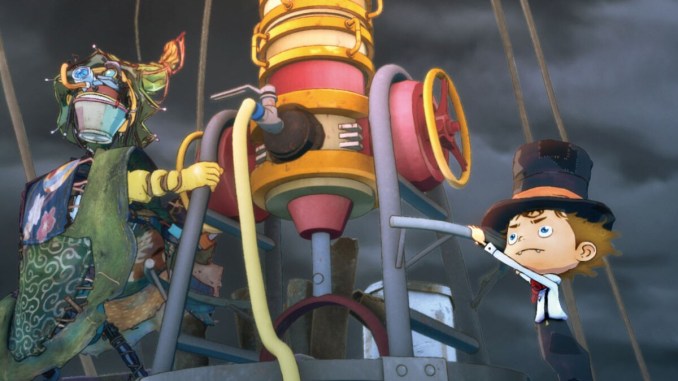 Perfect for audiences that like their cartoons dramatic and dark, Poupelle of Chimney Town uses polished Japanese animation to tell a complex story of friendship, acceptance, environmentalism, and– the folly of authoritarian states?


 “With great power comes great responsibility.” A group of children in an apartment complex realizes they have a strange and often dangerous bond. They possess otherworldly powers. As the connection between the children grows, so too do their abilities. The Innocents plays like a mysterious superhero and villain origin story.
 The complexity of The Innocents is endless. This young cast carries a heavy emotional weight. They delighted and terrified me. The evolution of this dark sci-fi narrative gave me full-body goosebumps. The volatility of young feelings is on an entirely uncharted plain. What these characters do with their power speaks to the purity of good and evil. Look for an extraordinary turn from


 TOPSIDE is a dark and dispiriting portal into the literal underbelly of New York City. The film follows a suburban community hidden amongst the subway tunnels of the city, and the struggles a mother and daughter face when they are suddenly evicted from this home. They are forced to venture up onto the city streets, but even there, there’s no real light to be found. Powerful but stomach-turning, this stuff is bleak with a capital B.
 By contrast, Little’s first experience in the sunlight is traumatic and saturated with new noises and fears. The narrative moves behind Nikki, and here the film began to lose me. Where Little’s view is full of naïve wonder, Nikki’s is laid low by the crushing reality of her circumstances. However wonderful life in the tunnels may seem to Little, there’s no romancing Nikki’s reality. But it also quickly becomes clear that those dark, dirty tunnels below Manhattan are in fact far safer than what lies ahead.


 The Thief Collector is a film that is not what you expect. The film is nominally about the theft of de Kooning’s painting Woman Ochre from the University of Arizona in 1985. The painting was cut from the frame and carried off by a couple not long after the museum opened on the day after Thanksgiving. Where it went or who took it remained a mystery for decades…until it was rediscovered in the effects of Rita and Jerry Alter. While that is a part of the story, the film actually is a look at the Alters and their obsessions. This is not a look at the crime but at the way people feed their obsessions and how seemingly normal people almost always seem to have another side to them.


 A look at the US policy under Donald Trump to separate illegal immigrant parents from their children. It focuses on the plight of several women who had their children taken away as well as the mothers turned activists who fought to reunite the family. The film focuses on how mothers from across America came together to create Immigrant Families Together (IFT) which was aimed at working to get the separated families together any way they could. In the case of Yeni Gonzalez, the women drove her across the country in stages in order to get her and her kids back together.


 DIO DREAMERS NEVER DIE was not one of the films I picked for the SXSW dance card. It was so low on my must-watch list as not to be on it. Frankly, I had no idea the film was playing at all. Then somehow I noticed it when I was putting things on and off my must-see list and added it simply because it fits a slot.


 Bobby Cannavale, Rose Byrne, Celeste Barber, Daniel Webber, and Thomas Campbell give superb performances. Seriously Red lives and breathes in screenwriter and star Krew Boylan. She brings unbridled nuance to Red. Comedy timing from the gods, slapstick chops, and a voice for days, Boylan owns every scene. You can’t take your eyes off of her.


 Urara Takano plays Kingyo, a voice actress whose passion for her work is clear to the audience from the very beginning. In 15 minutes we get an emotional journey worth every second of screen time. Competing with a new generation proficient in self-promotion, how does a dedicated veteran compete? The Voice Actress gives us a peek behind the curtain that is the boys club of entertainment, while simultaneously putting us inside the mind of an accomplished performer. Writer-director Anna J. Takayama gives Takano space to bloom. I would happily watch a feature on this character. There is a purposeful beauty to the costumes, especially the use of the color red. The undeniable quirkiness from Takano makes you fall in love with her. It’s no wonder the short garnered SXSW22’s


 You can see the momentary panic on the faces of friends, family, and frontline workers wondering where to place their small white flag in an eventual sea of over 700,000. We hear the intimate audio, prayers, sobs, and send-offs that no person dreams of giving in this way. Beyond that, the sound design is simple, the wind blowing gently against each tribute. The result is like the sound of the ocean. The title serves as a triple entendre, echoing the relentless tragedy of the ever-evolving virus, the flapping of the flags, and the words of the Japanese Death Poem by Seiju.


 I appreciated the way the film leaned into its theater roots without becoming too highbrow. There’s clearly a linkage between Lilian’s decisions and her performances of Hamlet and Lady Macbeth, but you also don’t leave the film feeling like you need to get a Ph.D. in Shakespeare. Leo does justice to Lillian’s trauma and sorrow, but she also imbues her with a winking charm. This film features one of the best-planned alibis I’ve seen in a thriller, and some of the methods Lillian employs for revenge were positively refreshing in today’s age of shoot-em-up thrillers. When a gun goes off in this film, it means something.
 Leo and Thorne are backed by an excellent supporting cast. Weary sure looks the part of a rock star, but I couldn’t get over how obviously dubbed his singing was during musical scenes. He and Leo have a beautiful soft dynamic together. I could watch Adrian Martinez in anything, and he provides a necessary bit of levity as the body count rises. I especially appreciated the way that Michael Potts’ Detective Eaton evolved over the course of the film. His final exchange with Leo sends the film off on a high note.


 Jane and Charlotte find common ground in parenting styles and celebrity. They speak openly about Jane’s lifelong dependency on sleeping pills, inspiration for songs, and her various marriages. The loss of her daughter Kate was perhaps the most impactful event in her life. The grief she carries is palpable. Jane and Charlotte discuss maternal guilt. It’s one of the most poignant through lines in the film. Charlotte’s eye and adoration for her mother are written all over this doc. It’s a lovely ode to a beloved icon from a daughter who continues to idolize her. As a mother, Jane By Charlotte has a revelatory feeling of intimacy. Gainsbourg‘s documentary makes me jealous in the best way possible.


 Shudder original
 Writer-director
 As Kiera investigates the house’s history, we are introduced to everything from Jewish mysticism to quantum physics. I wasn’t expecting math to be a thing, yet here we are. I thought the record player that coaxed the family members into all sorts of trouble was clever. But, not so much the characters googling Latin quotations. It’s a lot. There are fleeting moments of greatness, such as an ancient abacus moving on its own, air blowing from underneath the cellar door as if a creature were heavily breathing. The classic scares worked best for me. The final 20 minutes is where the real action occurs, a clear nod to

You must be logged in to post a comment.