

presents
Misha and The Wolves

Misha and the Wolves is the dramatic tale of a woman whose holocaust memoir took the world by storm, but a fallout with her publisher – who turned detective – revealed an audacious deception created to hide a darker truth.
 I’ve never trusted wolves. You could argue this is because I’ve always been raised around ultra-docile dogs, but I think my 20+ years of watching movies are really to blame. The ratio just doesn’t hold water. For every domesticated wolf acting as Kevin Costner’s sidekick, there are countless more stalking our hero through a snowy tundra, howls echoing through the night.
So you could imagine my skepticism when faced with the story of Misha Defonseca. Here is the supposedly true story of a young Jewish girl who evaded the Nazis in the woods of Europe during WW2 by falling in with a pack of wolves. In Netflix’s stirring documentary, we hear Misha describe being taken in as a Mowgli-esque family member – traveling with the wolves and surviving on scraps from their hunts. It’s one of those “you have to hear it to believe it” type stories – I mean, these are wolves we are talking about! It’s crazy to believe that Misha would be seen as family instead of a feast.
And yet, aren’t all stories of Holocaust survival are to some degree impossible? At their core, they are all linked by showcasing the triumph of the human spirit against overwhelming circumstances. So it is not surprising that we are swept up in Misha’s story, just as the world was in the early 1990s. A book deal, publicity tour, and movie option are a natural fit for such a fantastical tale.
 Sam Hobkinson’s smooth direction compels the audience forward. There’s a charming and particularly modern manner to the way that Hobkinson features key figures in Misha’s journey to stardom – their whole essence summarized into a single characteristic (“The Publisher”, “The Journalist”) We are not really meant to get to know these people (although “The Survivor” radiates winking humor with deep emotion in her few minutes of screen-time) – they are here to feed us the facts we need to drive the narrative forward, to build momentum towards the film’s core question. Which is, of course, can we believe Misha?
If you want to play detective, you’ll find the answers to Misha and the Wolves questions pretty quickly. A quick Google search will do the trick. The affirming or refuting of Misha’s story is only one part of the equation. Hobkinson’s film stumbles slightly on this follow-through: the film concludes with finality on the situation but left me wanting more on the motivations beneath the surface. A more rigorous interrogation would have been appreciated, but it is also fair to acknowledge that it might not have been possible.
Whether it be based on truth or lies, this is ultimately a story of family, legacy, and survival. Philipp Larkin once summed this story up a little more quickly:
“They f*ck you up, your mom and dad.
They may not mean to, but they do.
They fill you with the faults they had
And add some extra, just for you.”
Larkin was more to the point, but there weren’t any wolves.
*Streaming on Netflix on August 11th*
Written and Directed by Sam Hobkinson
*Official Selection Sundance Film Festival 2021*


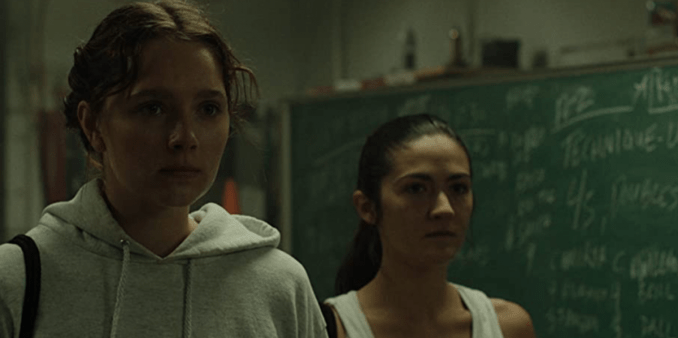 Quick take editing alongside exaggerated and repetitive audio gives the film urgency, all while a string-heavy score plays underneath. The culmination of all these elements lands The Novice somewhere between tense and inspiring. Then there is Furhman’s performance. Her obsessive behavior pushes The Novice past genre definitions. Furhman brings a ferocious passion to the role. Writer-director Lauren Hadaway‘s script is ultimately not about rowing. It is about mental health. It keenly delves into privilege, relationship dynamics, competition, and self-harm. The energy of this film is extraordinary. Bentonville Film Festival audiences will be hypnotized by its greatness. It is a must-see.


 Drugging his family and holding them captive in a bunker aside, toxic masculinity is smartly displayed throughout John’s journey. It appears in a spit fight, inappropriate conversations, and almost drowning a friend. The culmination of these moments keeps you tense and extremely uncomfortable. John and The Hole is unpredictable. I believe the most disturbing aspect of Nicolás Giacobone‘s screenplay is actually the final scene. Not wanting to spoil anything for the reader, I was horrified. The reasons are a complex mix of socioeconomics and Giacobone’s understanding our how the world functions. John and The Hole begs a larger conversation about aggression, pressure, and parenting. Do not miss this film.

 Ride The Eagle is a one-of-a-kind film. The script is written by director Trent O’Donnell and star Jake Johnson. Tackling regret, forgiveness, and everything in between, there’s an honesty that stings and inspires. Mostly, Ride The Eagle makes you smile.
 The script is filled with quirky characters. J.K. Simmons is fantastic in his manic energy. His delivery makes you involuntarily grin. Susan Sarandon, who we only see in her videotape to Leif, gives us warmth, and wisdom, and a boatload of snark. Her dialogue is yet another example of the care taken by O’Donnell and Johnson in their writing. There is a specificity that allows us to sit in Leif’s emotional shoes.
 I want D’arcy Carden to be my new best friend. The scenes between her and Johnson are pure gold. Their chemistry is off the charts. Made even more impressive by the fact that they speak exclusively over the phone. It’s like watching a masterclass in scene partnering. Their report nudges the script into rom-com territory. But, in truth,
  The score is vibrant and incredibly thoughtful. Ride the Eagle shines with heart and charm. It has a palpable vulnerability that makes it undeniably relatable. Of the nearly 200 films I’ve seen in 2021, Ride The Eagle easily soars onto my top 10 list.

 If an innocent man was sitting in front of you, would you even know it? This is a question I asked myself several times throughout Enemies of the State, Sonia Kennebeck’s propulsive new documentary. Years ago, movies made these kinds of questions easy on us: there’s that old western stereotype of the gunslinging hero wearing the white hat, staring down a villain dressed in black. These days, our digital lives have complicated that confrontation. In a world where stories of hackers, deep fakes, and police corruption flood the headlines, who can truly be trusted?
 In a film where nothing is certain, Kennebeck’s balanced direction is welcomed. Pains are taken to give equal air time to protagonists on each side of the conflict, to keep the viewer in check. I naturally found myself empathizing with DeHart’s family early in the film. In the immediate next scene, the camera lingers on the variety of medals on Detective Brett Kniss’ walls – as if to say, “You don’t want to believe this guy? He’s an Eagle Scout!”


 Andy Karl stars as Michael, a recently deceased, narcissistic actor who takes the idea of love for granted. When forced to find his soulmate, things get more complicated than he ever imagined possible. Finding a woman he connects with that happens to be alive makes for quite the twist. There are a lot of dynamic ideas in Here After, but its runtime drags the film down. It has some GHOST similarities, including a surprisingly dark edge I was not expecting in the least. The brightest moments come in two forms. First, the genuine chemistry between Andy Karl and his love interest Nora Arnezeder. She will charm any viewer with a single glance. Her nonchalance and likeability are gold. Karl, who I adore from his work on Broadway, is equally strong. He is the perfect balance of tenacious, fumbling, and vulnerable. Arnezeder’s and his down-to-earth dialogue makes this relationship fun and relatable. These are winning scenes.
 Christina Ricci is our other shining star. Each appearance puts a smile on your face. She has this innate presence about her. Ricci’s character could be a separate script, entirely. The mood changed drastically whenever she and Karl shared the screen. Writer-director Harry Greenberger had the opportunity to lighten the overall tone with a more upbeat score and tighter editing. I absolutely appreciate the risk in including an aspect of danger. It undoubtedly kept me on my toes. While the climax had a plot hole or two, I’ll give Here After a pass in this category for its beautiful message and authenticity.


 This story might have fared better as a miniseries. In fact, I know it would have. With all the makings of a True Detective style, cliffhanger-filled crime-thriller, nothing quite pans out in a completely satisfying manner. Even at just shy of an hour and 40-minute runtime, there is a ton of missed opportunity and information that would have pushed Midnight in the Switchgrass into greatness territory. As it stands, it’s a bit of a rushed and disconnected mess.
 The soundtrack does not help. It feels forced and somehow creates a hokey feel. The editing, particularly surrounding Emile Hirsch‘s flashes, creates a perception that you’re missing some greater storyline. It’s simply unnecessary. There are moments when the acting is so over the top it’s nonsensical. Each character needed more time to develop. We hear about their pasts only briefly. This is yet another example of where further serial development would benefit the entire narrative.
 Bruce Willis is underutilized. He could have been any actor playing that role. Megan Fox wavers between totally believable and taken for granted. It’s her stunts that read fake, which is a tad baffling because we know she’s capable of action stardom. I’m not sure who to blame here. In her most recent film,


 The soundtrack is incredible. Even though you know the outcome of the final game, watching the tape makes your palms sweat and your heart race. You’ll stand up, cheer, and cry happy tears alongside the team. It’s simply inevitable. The film could not be more relevant as we roll into this year’s Tokyo Olympics. This team paved the way for female athletes to defy the masses. While it continues to be an uphill battle of sexism and controversy for today’s athletes, The Japanese Volleyball Team in 1964 owned their naysayers. Director Julien Faraut gave NBFF 21 audiences a history lesson that charmed the pants off of audiences.


 Dachra‘s initial formula is similar to The Blair Witch Project. Soon going off the rails into something we’d never imagined experiencing. What sets this film apart is remarkable cinematography and ghastly twists and turns. The runtime is lengthy but necessary to place you inside the shoes and minds of our three protagonists. Being thrown into a new culture is oftentimes shocking and uncomfortable. Dachra takes discomfort to the next level. The script forces the viewer to endure a deranged and prolonged experience of hospitality. As the mystery grows, so too does the terror. So many questions swirl as the film progresses. This isn’t just one story. Dachra has franchise potential, with sequels and prequels possible.
 Sometimes a film has the ability to sear an image into your brain. It’s rare when one film does it over and over. Hatem Nechi‘s camerawork is both dizzying and hypnotic. The long takes are impressive and eerily effective. There is real movie magic in Dachra. I am scarred by some of the things I saw. Performances are nuanced and skin-crawling. The practical fx are gag-inducing. The fact that this is writer-director Abdelhamid Bouchnak‘s first film is mindblowing. This story is very carefully curated to scare the hell out of the audience. It’s the perfect storm of horror and history.


 Performances are top-notch. Greg Finley as Tommy manages to be both powerful and sympathetic all at once. There is a familiarity to his entire being that puts the audience at ease. Dylan Silver as Emma has an inspired tenacity that makes her a gorgeous foil for Finley. DOWNEAST could almost be considered an ensemble film. While the entire cast is incredibly solid, I feel compelled to mention one actor in particular. Kirk Fox‘s performance as Marty provides the much-needed levity to a heavy-handed storyline. He’s a star.
 Downeast was produced by APS Films and directed by Joe Raffa, who wrote a script based on a story by Maine native Greg Finley. Finley produced alongside Cory Pyke. Edwin Pendleton Stevens served as executive producer.
 Bad news. Being unlucky in love is genetic.


You must be logged in to post a comment.